NGUI Dynamic Layout Controls – Update

Over the last two weeks I’ve made some good progress on the layout controls for Unity using NGUI. I’m very close to having my old UIs completely replaced which means that I’m about ready to start polishing up everything and making it available for other people to use! In the process of replacing all of my old Unity UI code with my new NGUI controls I’ve uncovered a lot of bugs and design mistakes in my controls and fixed them. I also added quite a bit of functionality.

Two way data binding is now possible. This means that not only will the UI change based on the data context provided, but the UI can change properties on the data context. This is required for UIs that have input elements like checkboxes. I created a LayoutCheckbox so that checkboxes work in layouts and work with two way data binding. I still need to create a LayoutTextbox.

Data bindings can now support value converters. These allow you to massage values from your data context into what your control needs. As an example of this, you might have an “Updated” property on one of your game classes and you want to use a different font when it is true. Instead of having the class keep track of the fonts as well, you can create a converter that will be used by a data binding that will allow the data binding to get the bool from the class and set the correct font.

Previously, only LayoutScrollViewer had a max size property that allowed you to specify the maximum size a scroll viewer would take up in the layout. This has been moved to LayoutCapable (the layout base class) and concrete size has been added. Now all controls honor maximum sizes and absolute concrete sizes if you wish to specify them.

I also added a Visible property to LayoutCapable. This allows for data binding on visibility, and layout controls will no longer create space for controls that are invisible.

Here’s a short example of a much more complex UI that I’ve built using the layout controls. To show off the power of data binding, I’m showing the exact same UI with an empty data context and with a fully populated data context:

The demo makes heavy use of the ItemsControl, binding it to an ObservableCollection of objects that I create when the UI opens. The add and remove buttons directly affect those collections which in turn update the ItemsControls. I didn’t show how the UI got its data source, but I set it in some code.

Posted in Layout Controls, Unity | 3 Comments

Dynamic UI Layout in Unity using NGUI

I’ve spent a lot of time writing user interfaces using XAML. I loved (and hated) it. XAML has a ton of power and you can create some pretty amazing interfaces with creative use of the controls Microsoft have provided in WPF and Silverlight and data binding. None of that exists in Unity. NGUI is a plug-in for Unity that you can buy in the asset store that improves the UI story quite a bit. In fact, many Unity devs say that they wouldn’t use anything else. However, the creation of dynamic UIs still require quite a bit of code behind. I’ve been working on a game that involves a lot of UI with different amounts of information, and I finally tired of writing a lot of repetitive UI code. I longed for my days writing XAML – maybe I’m strange. To that end, I started working on a toolkit of controls to emulate some of the great features in XAML. Here’s my introductory overview video: http://youtu.be/Teglz9-dgU8. I need to stress that this is very early in development and that I’m learning as I go how to best demo these tools.

While that demo is nice, it certainly doesn’t cover everything I’ve done, and possibly some of the cooler features. In that video I cover my version of ItemsControl and StackPanel, simple data binding, commands, and some box model features. I have created more than those though, and I want to briefly list them here. As I mentioned in my video, if there is enough interest I’ll do videos going into more depth on each of these controls.

Scroll Viewer: I’ve created my own version of a scroll viewer. It allows you to place other layout capable controls inside it to scroll them around. It handles the placement of the content and the scrollbars to ensure that it stays inside its available area. In the demo video you can see a maximum size being set and how the scroll viewer responds to changes in the contained stacking panel’s layout.

Grid (For now, I have called it UILayoutTable to match an NGUI convention): Similar to the Grid in XAML you create row and column definitions, with the different sizing options proportional, auto, and absolute and shared size groups so that two grids can share row or column sizes (this is especially useful when creating a table with dynamic contents for row or column headers). This also allows you to do some simple alignments. The demo video starts with 2 rows and 3 columns all proportionally sized (they get an equal amount of space). The first column is then set to auto to show how it shrinks to the minimum size needed to contain the column’s contents, and the other two columns increase in size to take up half the remaining space. Then a row is added and one of the labels is placed on the new row.

TabPanel: Will automatically create tab buttons, with tab strip placement options, to view different tabs of UI elements. The video demonstrates how the tab panel works, showing two different locations for the tab strip and that creating a new tab is as easy as adding a new child to the TabPanel (the demo accomplishes this by duplicating one of the children.)

Data Binding supports binding paths so that you can drill down into a source or target using ‘.’ notation just like you would access the properties in code. For example, you can have a binding path of “SomeVectorProperty.x” to get just the x component of a vector stored at “SomeVectorProperty”.

Posted in Layout Controls, Unity | 4 Comments

Orthographic Camera in Unity

Unity is an amazing tool and engine for making games. It is specifically designed for making 3D games, but since 2D is just a subset of 3D it is still incredibly powerful for 2D games. While looking for advice on making 2D games in Unity, I came across a very helpful post by Josh Sutphin. He has a lot of great advice there, and with a few tweaks his UV mapping algorithm helped me a ton.

His explanation of the orthographic camera mode is a bit confusing though. I looked for a while trying to find a good explanation of how this camera mode works. Josh has two in his post, the first of which is a good top level explanation of what’s going on:

“The orthographic size expresses how many world units are contained in the top half of the camera projection. For example, if you set an orthographic size of 5, then the vertical extents of the viewport will contain exactly 10 units of world space. (The horizontal extents are dependent on the display aspect ratio.)”

Now for a concrete example of what he’s saying:

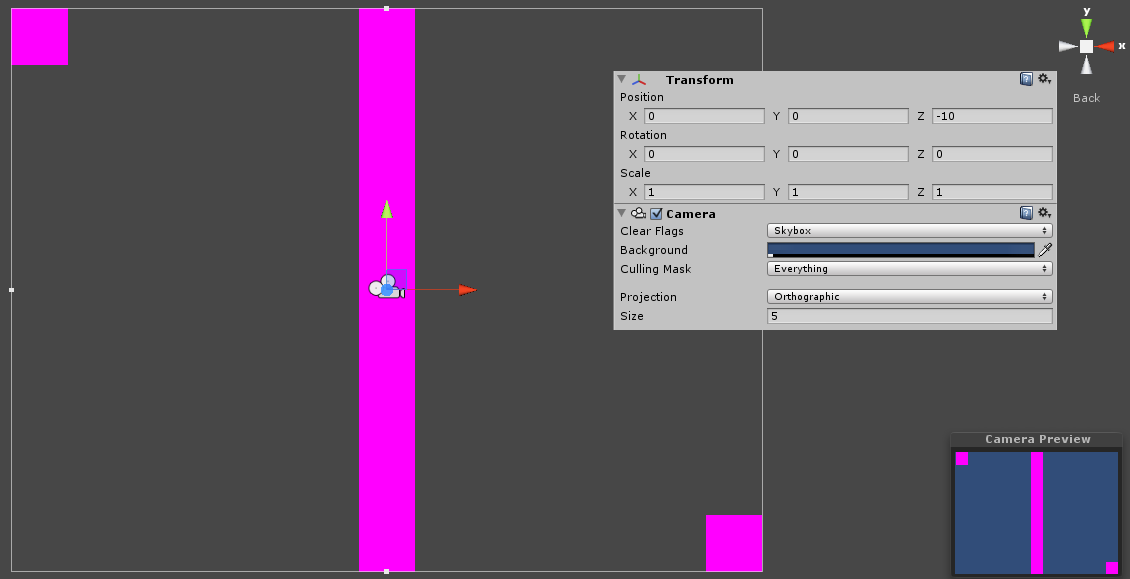
Orthographic camera settings

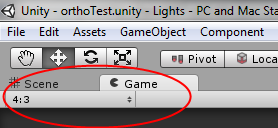
Here we have a camera set to orthographic perspective at 0, 0, -10 with no rotation and the orthographic size is set to 5. Therefore it is pointing down positive z, with (0, 0) at the center of the screen. Positive x goes right and positive y goes up the screen. Since the orthographic size is 5, it means you have 5 world units above and below the x-axis. If you are using a 1×1 quad, you will be able to fit 10 of them vertically from y = 4.5 to y = -4.5 (the quad is positioned by its center, so this would put the top of the top quad at y = 5 and the bottom of the bottom quad at y = -5.) If your aspect ratio is 4:3, you will be able to fit 10 * (4/3) or 13.33 of your 1×1 quads horizontally, from x = -6.133 to 6.133. As a side note – changing the aspect ratio of Unity’s Game mode to the same that you’re developing for is really useful and can be done with a drop down in the upper left when you’re in the Game mode. This will also change the aspect ratio of the camera’s preview window.

Aspect Ratio setting

Now that you have the size figured out, you will want to decide how many pixels one world unit will be. For Unity you should be using textures that have height and width measurements that are a power of 2. Since you’ll be dividing by the height and width of your texture to get UV coordinates, your sprites should also be sized to powers of 2 to avoid floating point errors. In Josh’s post, he uses a ratio of 64 pixels to 1 world unit because he uses 64×64 pixel sprites. This means that his 64×64 pixel sprites map directly onto his 1×1 quad. If he had a sprite that was 128×64 pixels, he would scale his quad to be 2×1. This isn’t a Unity setting, it is just a convention that you will use when sizing your world objects to make sure your sprites will not be scaled or distorted.

Posted in Games, Unity | 3 Comments

Road Trippin’

Another friend has come to visit us! We’re exhausting our supply of people who can visit rather early, but that means that they get to spend a fair amount of time with both of us without having to sacrifice any of Adrienne’s vacation! It’s pretty great to be able to share a lot of what we’ve experienced here with people. (Note: Adrienne finally started working today!) This friend is also named Ben, which makes talking in the third person awfully confusing, so to make it clear: I will be referring to myself in the first person throughout this post.

Ben had already spent some time in Australia a couple years ago. Instead of showing him all of the cool things we’ve seen around Sydney, we decided to take a road trip after Christmas. Adrienne posted about our Christmas antics, but needless to say: we had a pretty amazing time. It’s been really great having some familiar faces around to share the holidays.

So. We set out from Sydney on the 26th in a car that Viive and Ian were kind enough to let us barrow, packed to the bursting point with food and camping gear that Viive and Ian were kind enough to let us borrow. Viive and Ian were really the sponsors of this trip. I’m not sure how to thank them enough. As should be expected, we really had no real plans outside of “towards Melbourne, then maybe to Adelaide if there’s time.”

An hour or so after we left Sydney, Adrienne found in one of the books that she and Ben had the foresight to rent the library the park where we spent the next three days. The park had some free campgrounds, lots of animals, and Australia’s Tallest Mountain, with a peak at 2,228 meters (7300 ft) – see if I hadn’t bolded it, it wouldn’t have seemed nearly as cool. On our first night there, we saw wild(!) kangaroos for the first time, about 15 meters from where we set up camp. It was so cool! Additionally, I had my first night’s sleep in a swag. These things are awesome. They are essentially fully enclosed mattresses. Ours had a zip off flap on the top, so we fell asleep looking up at the stars without having to worry about being eaten by mosquitoes or being kicked by a rogue ‘roo. Awesome!

We continued our path through the park, stopping at various points to get cave tours, and explore a couple caves all on our own. One was even unlit! Here we saw some small bats flitting around. On the way down from Australia’s Tallest Mountain we came across an echidna waddling its way across the path and up the rocky slope.

Most of the camping sites we stayed in were nothing more than some flattened land with an onsite toilet, so it was nice when we found ourselves in a campsite with working showers and hot water! Definitely the exception to the rule. That night became more interesting when we found out that we accidentally stole someone’s campsite: the sites marked “late arrivals – 1 night only” are apparently available to be booked online. The park ranger who directed us to the sites didn’t mention that. The people were very gracious though, and everything turned out fine.

We spent a couple days in Melbourne eating some good food, staying in a motel that was far nicer than any of us expected, and looking around some great museums. The Melbourne museum lives up to the quality of museum we’ve come to expect in our time in Sydney. Very cool museum that we didn’t even cover half of in our day there.

Next we headed a bit more south to see a rain forest that promised glow worms! We went out one night to the park where they are and walked one loop around the trail while it was still mostly light one in the dark. There are some really big trees here. After night fell, if you looked into the dirt walls near the trail, you’d find little pin-pricks of blue light spaced a few inches apart all over. Oh, and on the way to the park, we caught a glimpse of a swamp wallaby! I’ve been wanting to see a wild one for quite some time. Add two more really cool species to the list of animals we’ve seen in the wild here.

Then we decided to head home. 12 hours is a bit of an awkward amount of time to drive. Definitely doable in one day, but that is one really long day. We decided to take one brief hike in hopes seeing a cool orange fungus (we didn’t, but we did get to see more, really big trees) and then drive home. This is where everything fell apart. After about 10 hours on the road, our car decided it had had enough and we blew the head gasket in the engine. At 10PM. Luckily, we were near a small town that had motels and car repair shops. Unluckily, the only motel that has 24 hour check in was fully booked, so we slept in the car. It’s easy for something like this to ruin a trip in your memory, but all of the great wildlife that we saw really made it worth it. By the way, we also saw a really cute and fearless possum at a campsite that we had all to ourselves, and a koala on the side of the road watching the cars go by. Koalas are way more interesting in the wild than in a zoo. Especially when they sit at the side of the road watching traffic.
Posted in Australia | 4 Comments

Creepy Crawlies

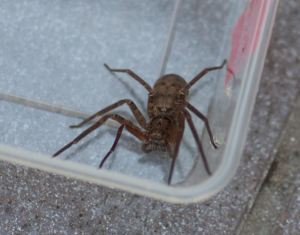
Male huntsmanAh, the Huntsman. They’re big, creepy, and fast! It turns out that most of the critters here, even the dangerous ones, are quite skittish. Huntsman are no exception. It would be much easier to catch them if they stood their ground. But, rationally, they are scared of us. We could easily crush them to death. What can they do to us? A little pinch of a bite. Painful, sure, but nothing you wouldn’t get over in an hour. It’s silly, but when confronted with one there is a powerful urge to not be in the room anymore. Anywhere else would be preferable. Even Adrienne hates them, and she’d be excited to find the Sydney funnel web, (dramatic voice)Australia’s most toxic spider(/dramatic voice)! We’ve heard the story twice now of the person who jumps out of their moving car because they put the visor down to have a huntsman fall in their lap. You see, huntsman usually live under tree bark. They like dark, tight spaces. A car’s sun visor is the next best thing!
Female Huntsman

The female huntsman. Much larger body than the male, but a little shorter in the legs. A bit smaller overall.

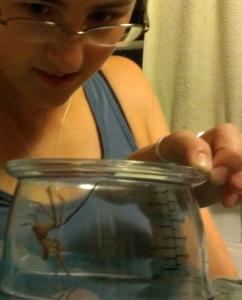
They’re the large spider that everyone hears about from Australia. When I told people we were coming here, one of the things I heard was “that’s where all the big-spider-in-the-shower pictures come from!” I came here prepared to find one every other day. Then we didn’t. In fact, at first, the worst thing we had was a few moths. Then we got a few cockroaches (more on these later.) I relaxed. This made finding two back-to-back so much worse. In my opinion, the second, the female, was the creepier of the two. I helped a bit in the capture of the first, but Adrienne captured the second before I even knew it existed. We eventually set both free: creepiness is certainly not a death sentence. We kept the female overnight, and I figured maybe looking at it every now and then would acclimate me to it. Nope. Still really creepy, and I will definitely jump on the nearest high surface when we find another. Not that that will help much, they’re expert climbers.

And now an interesting note about cockroaches: Australian cockroaches are considered very beneficial. They stay in gardens and help fertilize and generally keep green areas healthy. The pest cockroaches that are here are all invaders. They’re mostly European, and vary widely in size. We’ve found tiny little ones, smaller than a dime, and ones larger than a half-dollar. The Australian ones aren’t fast and skittery. Apparently some people consider them good pets. The European ones are a pain to remove because they’re fast and squeeze under anything. However, we have found that stuffing a sweatshirt at the base of our door greatly reduces the number of bugs that make it inside. Hurray solutions!

Posted in Australia | 3 Comments

Human Detection

I used to have a CAPTCHA on my blog to try to prevent comment spam. It didn’t work. I’m sure you’ve noticed that CAPTCHAs are becoming more and more difficult to read; this is “necessary” because computers are getting better and better at figuring them out. The CAPTCHA I had was very simple, and it has become clear that the bots could easily bypass it. That’s why I’m excited to update to a game as my human test. It’s an intuitive and cultural test rather than a test of reading skills.

Now, if you try to comment on a page, a little game will pop up before the comment goes through. That pop-up will ask you to do something like: “give the players their sporting equipment” or “feed the food to the baby.” Yes, it’s a little more time consuming for you, but it only takes a few seconds to play and it saves me from mounds of spam! In fact, here in Australia, it take longer for the game to load than for me to complete it.

I think this is a super cool way to filter humans from robots. And when robots can get around this, I’ll just be excited that we’ve created an AI that can complete this kind of cultural test!

Posted in Blog | 3 Comments

Rule #32

We’ve been in Australia for two months now; we’ve explored beaches and forests, eaten delicious food, and experienced some of the culture. It’s been a blast! But there are a lot of little things that make living here enjoyable that are easy to gloss over in blog posts. I’ve briefly mentioned some of them in previous posts, but to exercise some of the survival skills I learned in Zombieland, I wanted to spend some time enjoying the little things.

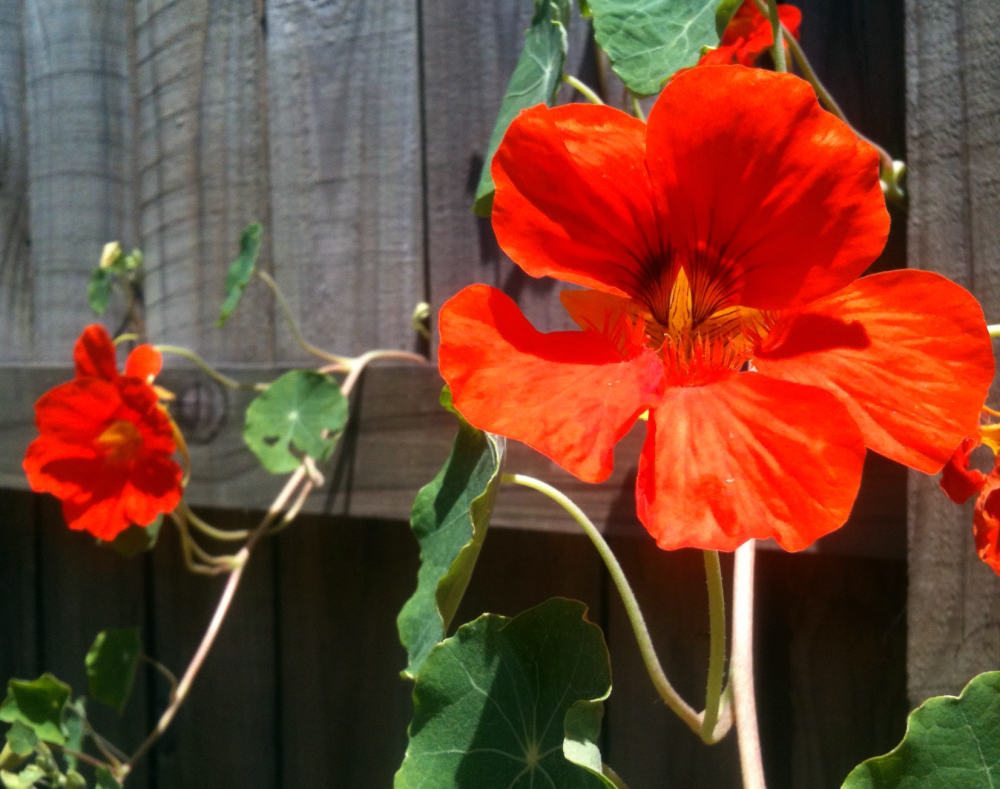
Orange Flow

A vine has crawled through the fence from the neighbors yard. It has these striking orange flowers.

Australia has quite a range of incredibly beautiful flowers. Some of them are strange, petal-less bulbs. Others have incredible coloration. Recently, one type of tree with brilliant purple flowers has started blooming. The flowers are so densely packed on theses trees that it almost looks like they have purple leaves. These trees provide excellent contrast when outlining other trees, and are striking when you come across a row of them lining a street. Many of the flowers here seem more vibrantly colored than the ones back home, and the patterns many of them have in their petals are very cool. Everywhere we look seems to have one sort of pretty or another for us to bask in. I guess its what we get for moving to a more tropical place!

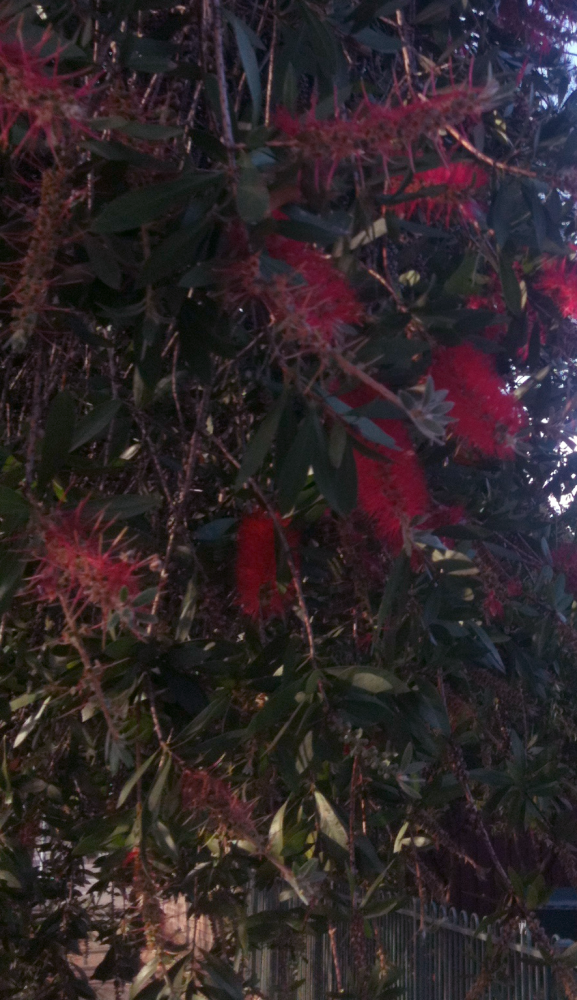
Petal-less Red Flowers

This type of tree becomes covered in these cylindrical clusters of petal-less flowers.

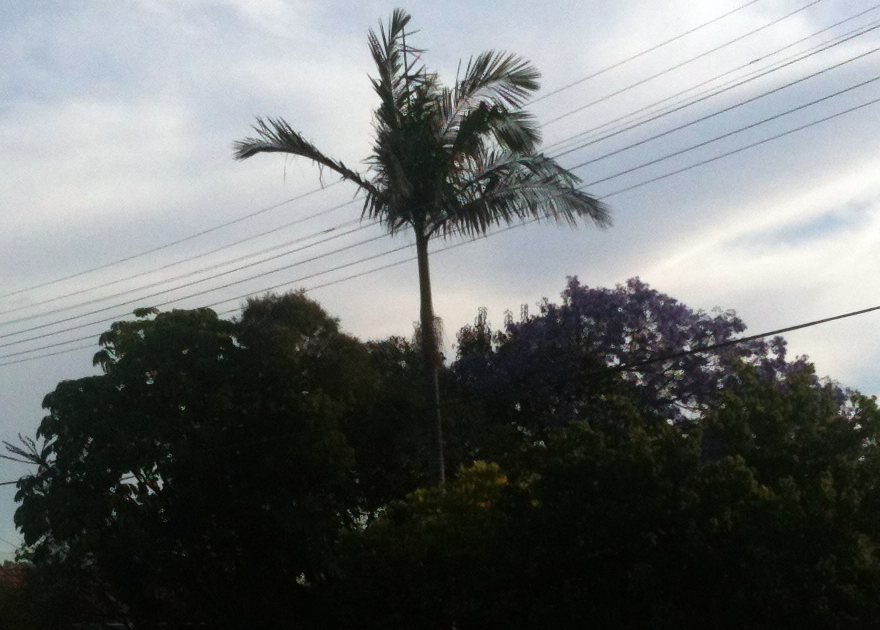
Purple Flower Tree

My phone camera isn’t great for capturing this, but I love how the tree on the right provides nice purple accents to the rest of the trees. It’s a bit more clear if you blow the picture up.

The bird calls are much more interesting as well. There’s the Australian Raven, and the Kookaburra, and the Lyrebird, and just about everything in between. The Australian Raven has long low caws that sound like it could be a dying cat. While taking a run a few weeks ago I came across a flock of them loitering around a park, their white eyes are too far forward and they have these scraggly feathers on their neck. Truly, a bizarre and creepy bird. We heard Kookaburra more often out where Viive and Ian live. Their call really does sound as if they are laughing, and I can’t help but laugh along every time I hear them. Adrienne and I have taken to singing “Kookaburra lives in the old gum tree” in rounds when walking the dogs, wishing the Kookaburras to start up. Hopefully you watched the Lyrebird movie I linked to last time I talked about them. Adrienne and I actually got to see a male doing his dance the second time we went to the Blue Mountains! It was awesome! They can imitate so many sounds, and this one was doing a remarkable imitation of the stream it was standing near. Recently, a very strange bird call has been waking me up around 6. The closest thing I can relate it to is well oiled metal sheers. Obnoxious, yet intriguing. During the day, the birds are frequently noisy, their calls are so interesting, new, and different.

Many of the restaurants here allow patrons to bring in their own bottle of wine. It’s a pretty neat practice, and makes drinking in a restaurant actually affordable! They do charge a “corkage” fee per person, but this is usually only a couple dollars. We went to a restaurant last week on a LivingSocial deal without realizing that part of the deal was the corkage, so before our food arrived I quickly went out and got a bottle. Instead of paying 30, 40, or 50 dollars for a bottle of wine, we paid $12! Not only that, but if you plan ahead, you know you’ll be drinking a wine you like. You’re not restricted to what the restaurant carries. Do like.

There are a few little things that I can say I don’t enjoy much. First off, the internet here is really spotty. I don’t know if that’s purely because of the ISP, but we’ve had troubles everywhere we’ve tried to use it. It’s slow and frustrating. This is probably our biggest and most common gripe.

The street numbers here are also quite confusing. I haven’t been able to figure out what the pattern is yet, so if we’re looking for a particular address Google maps is a much better way to find it than by trying to find which way the numbers increase or decrease (the numbers may increase on one side, but decrease on the other.)

Posted in Australia | 3 Comments

Beaches!

About a month ago, Viive and Ian decided to go to their favorite beach, and invited us along. Avoca is around two hours north of Sydney, so they picked us up around 10:30 to drive up. On the drive, Viive told us about some very secluded islands we passed on the way. There are no ferries that go there, but people can pay to get a tour through them with the Riverboat Postman. She said she used to work with someone who lived on one of the islands, he had to row to shore every morning, where his car was parked, and then drive to work. I guess that’s one way to get your morning work-out and is certainly a much different way to live.
Adrienne and I packed a lunch, so when we got to Avoca we ate on the beach. The beaches around Sydney are even better than the ones I grew up with in Holland. Not only are they wonderfully sandy, but there are rocky cliffs to explore, too! We weren’t planning to do any swimming because the water this time of year is chilly, so we spent most of the day exploring the cliffs and tide pools. There were some people out surfing, they were all wearing wetsuits, that got me excited to surf again, but I’ll probably wait until the summer.
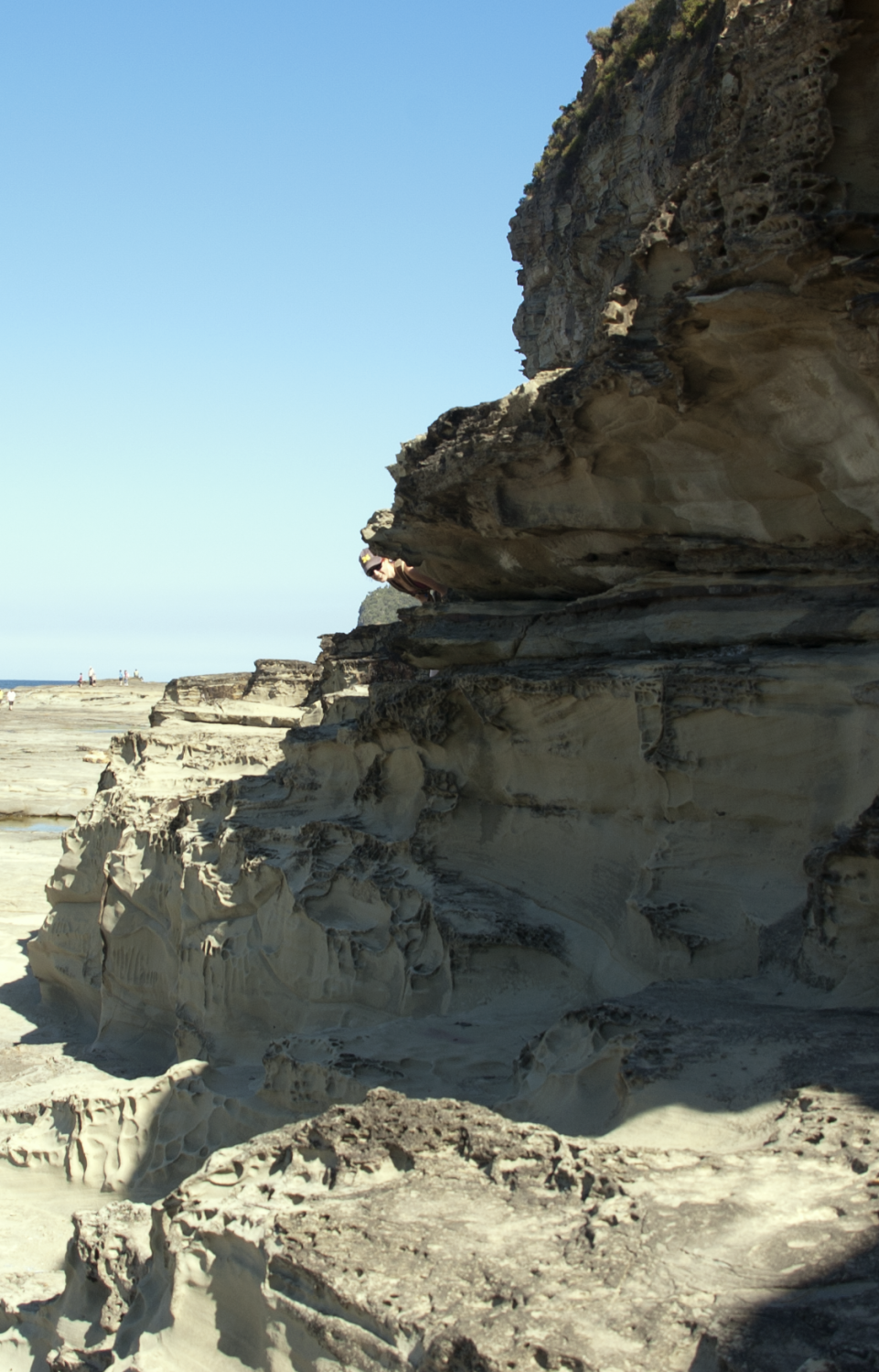
Adrienne among the cliffs

Adrienne saying hi from a cliff

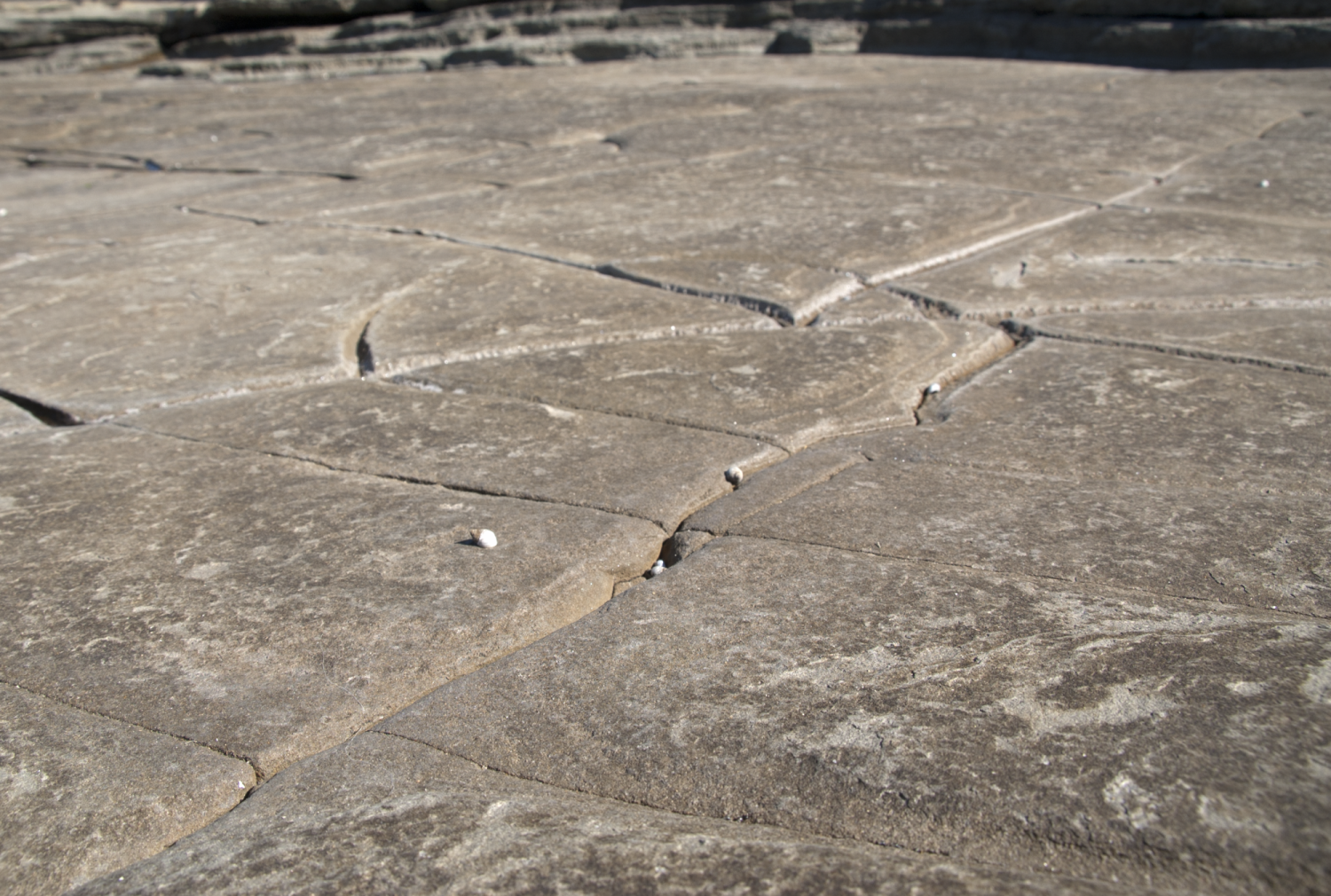
Cracked Sandstone

The sandstone is pock marked and cracked.

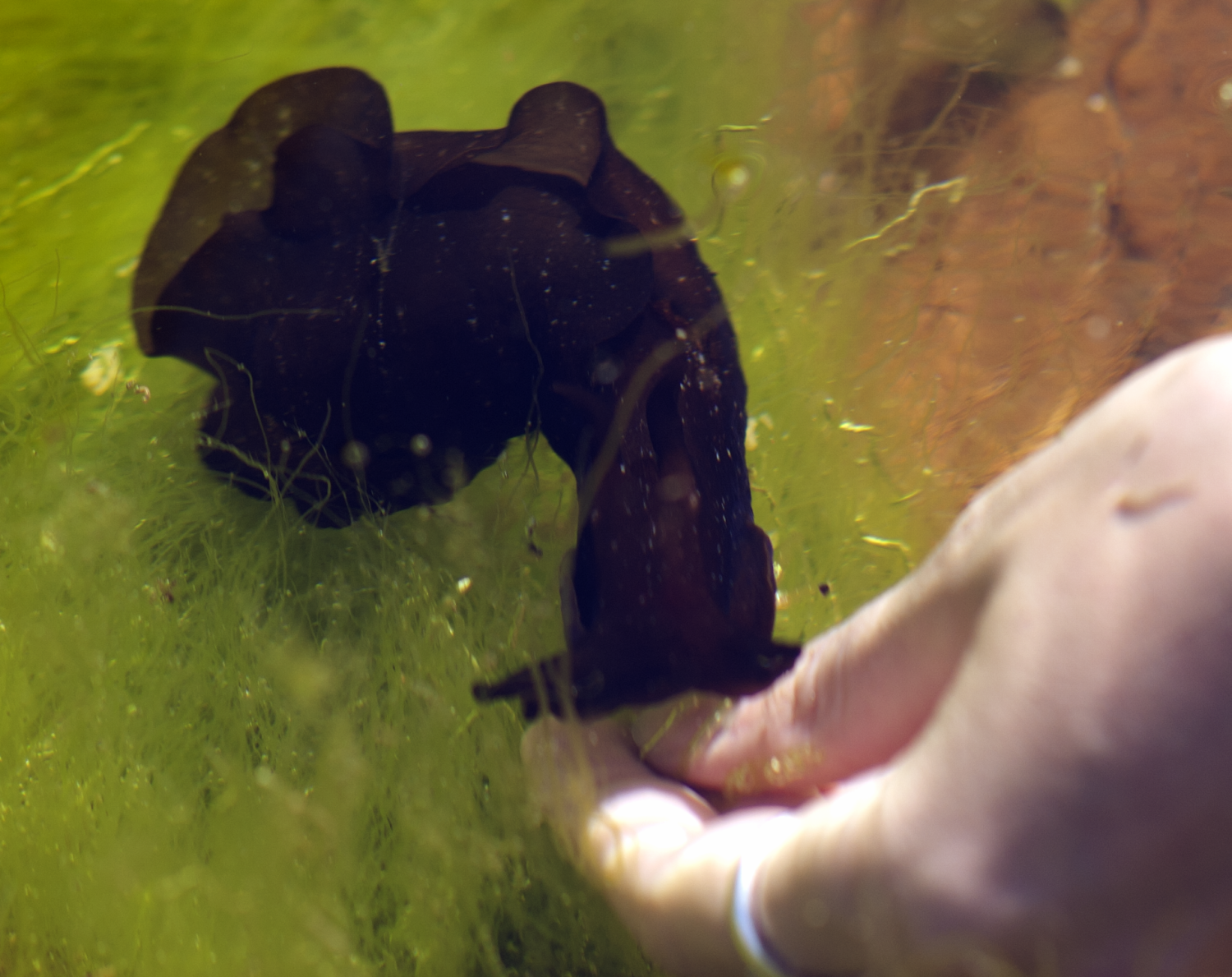
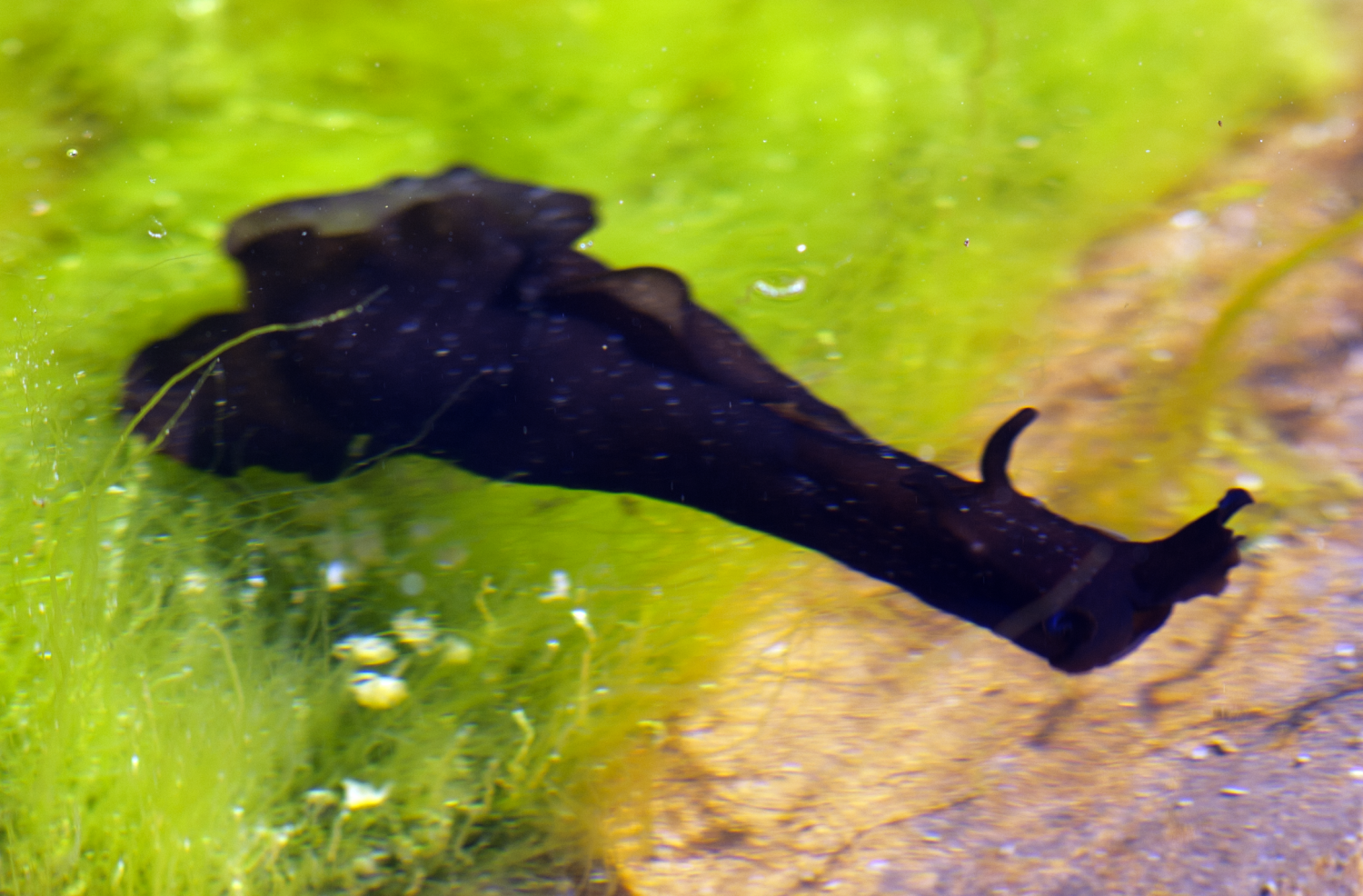
The theme of my Australia blog posts seems to be beauty, and Avoca didn’t disappoint. The sandstone of the cliffs are beautifully colored in reds and yellows, and has been carved into amazing formations. The ground is pock-marked with pits and pools of different sizes. Some are golf ball sized while others are large pools and every size in between. Some are really shallow, only an inch or so deep, others are like a basketball was carved out of the stone, and a few were big and deep. We even saw a couple people soaking in one of them. Many of the pools are big enough to support various forms of life: seaweeds, small fish, sea-snails, anemones, and we even found a sea-slug in one!

Adrienne and Slug

Adrienne had fun feeling what the slug was like, and tried to feed it.

Slug Stretching

The slug was extremely stretchy!

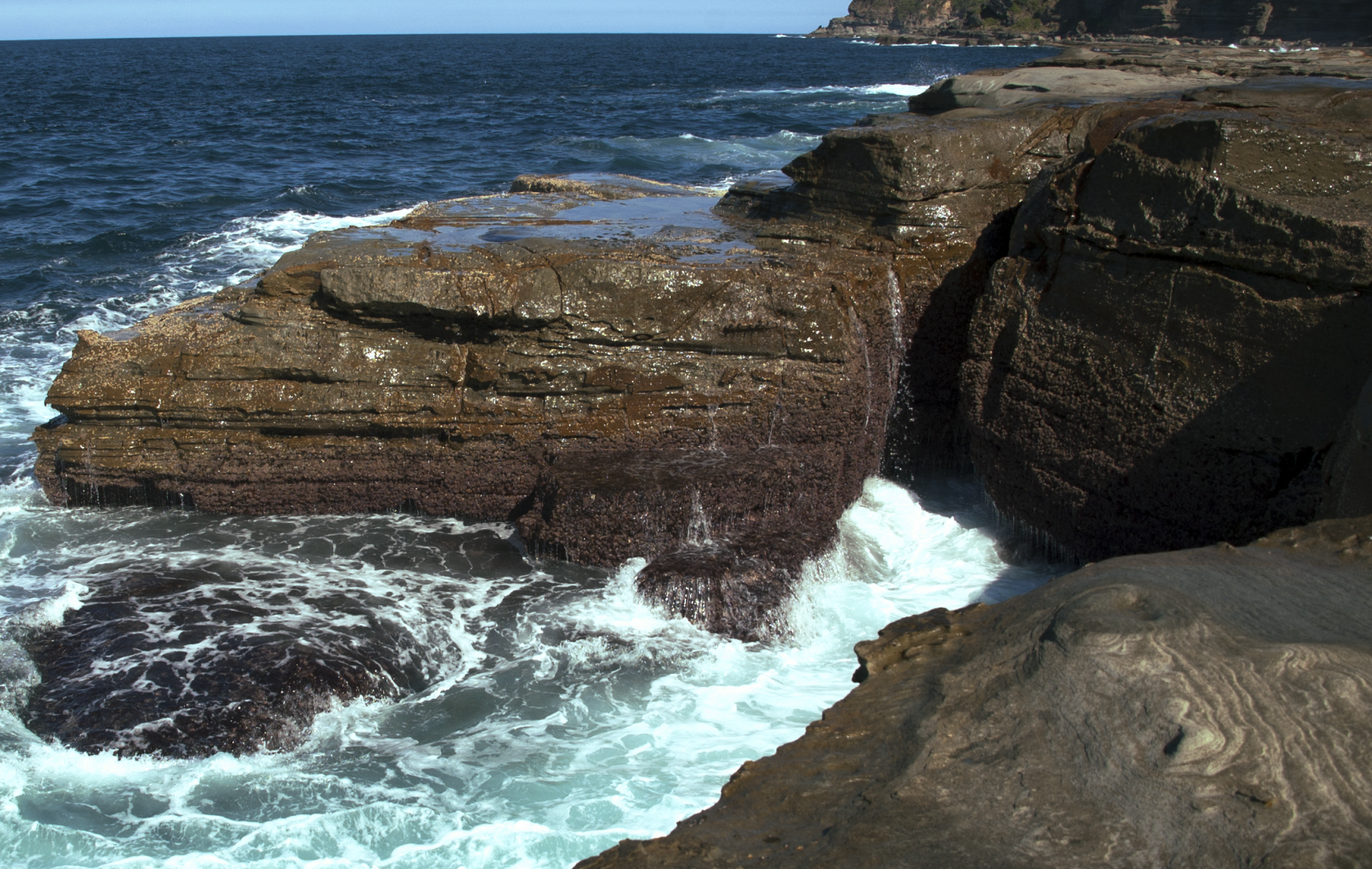
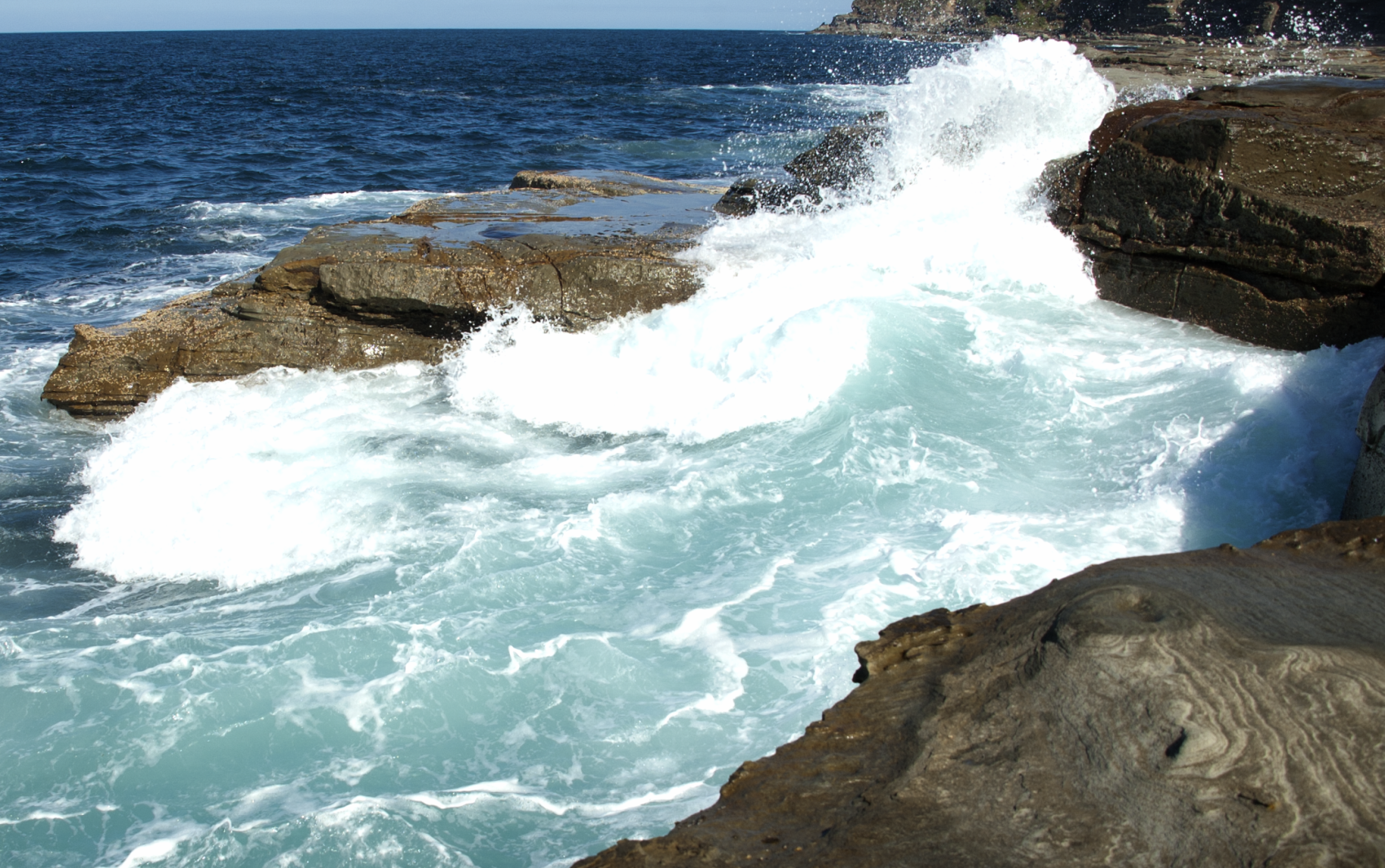
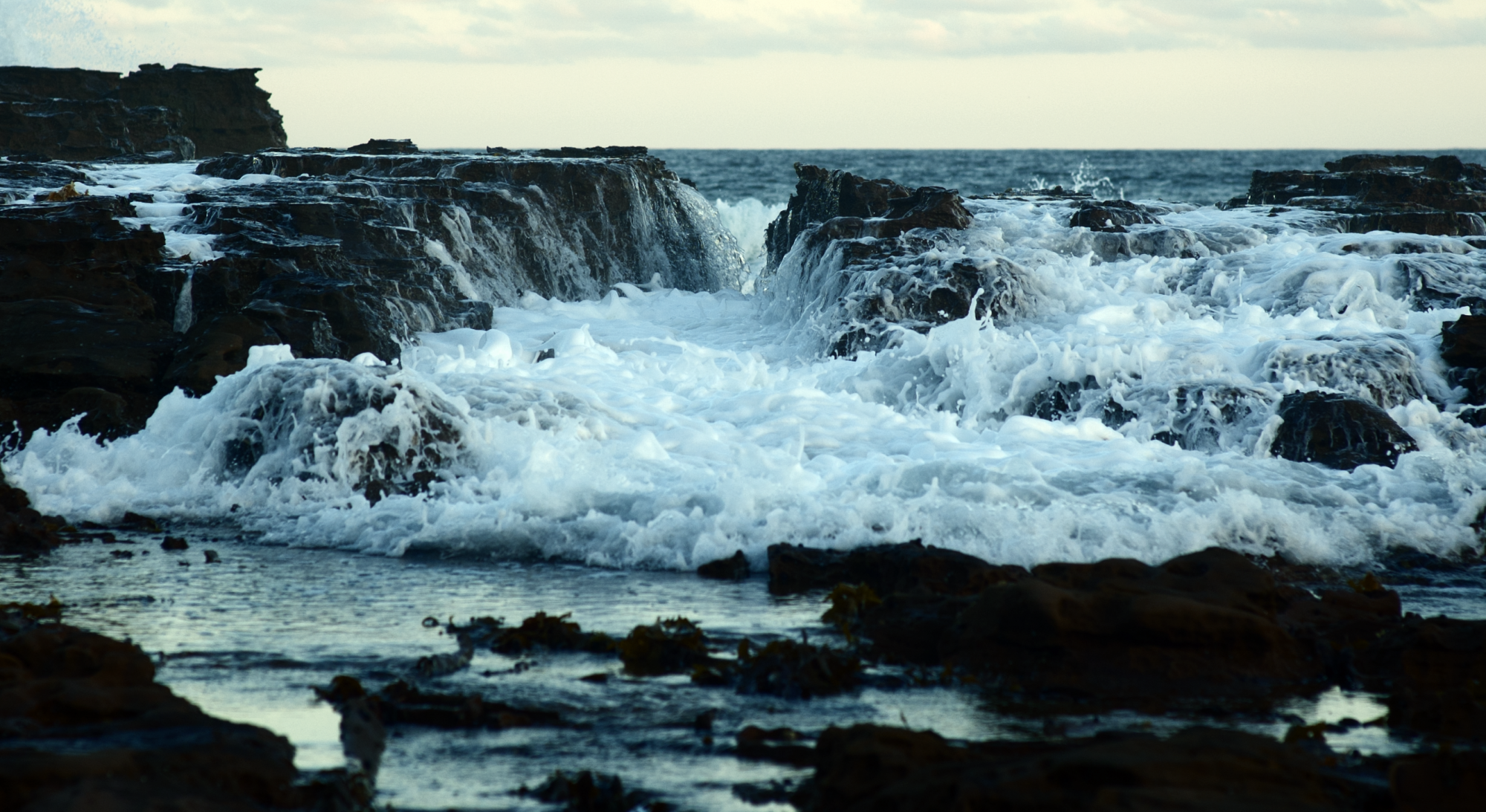
We also spent a considerable amount of time just watching the water as it slammed and swirled into and around the rocks. I always find it relaxing to watch and listen to waves as they crash into the shore. Being on the rocks really gives a sense of the ebb and flow of the ocean, the difference between the crest and trough of a wave is really striking and illustrates the power of the ocean. It also helped me to visualize what a tsunami might really be like. There wouldn’t be a giant cresting wave coming to shore like you would see someone surfing on, but the water level would just get higher and higher.
Wave Trough

Here the wave is at its lowest, the water seems to flow away and expose at least 10 feet of the rock.

Wave Crest

Then the wave comes in and crests, completely covering the rocks.

In between beaches, we stopped at a gallery for the photographer Ken Duncan. He takes some really amazing landscape photos. We were in luck: the gallery was running a sale on posters, so we picked up some much needed wall decorations for our flat.
Evening at the beach

We went down to a different part of the beach once more in the evening, as the light was getting long. The water running amongst the channels it has carved in the sandstone is beautiful.

Since going to Avoca we have been to many more beaches in Cronulla, La Perouse, Manly, and Bondi. We usually leave in the morning and bring a lunch, and have tried to get to many of the beaches during low tide to walk among the rocks and pools. We’ve collected some nice shells, seen a lot of cool sea life, and even found an octopus! Adrienne is thinking about using all the deep purple urchin spines we have collected to make some jewelry. Since we bring lunch, I get to have wonderful picnics (sometimes Adrienne doesn’t eat, or quickly devours her food to get back to searching), basking in the warmth of the sun on some rocks amongst the beautiful cliffs and listening to the ocean. Most of the beaches are in small bays that are on the coast and have sidewalks parallel to the water, along the beaches and cliffs. There are almost always people out running when we’re walking them that make me really jealous of their idyllic running routes.
In Manly, we stayed around one area for most of the day as the tide went out. It’s a really interesting experience, because you don’t really notice the water level going down. You just turn around and realize that where you are was under water just a couple of hours ago. What an amazing phenomenon.
We didn’t spend much time on the beach or in the rocks at Bondi, we were there for the Sculptures By The Sea event. There were some pretty cool pieces of art scattered along a walk between two beaches in Bondi. I took a lot of pictures, and after editing will post some here.
Posted in Australia | Comments Off on Beaches!

Australian Museum

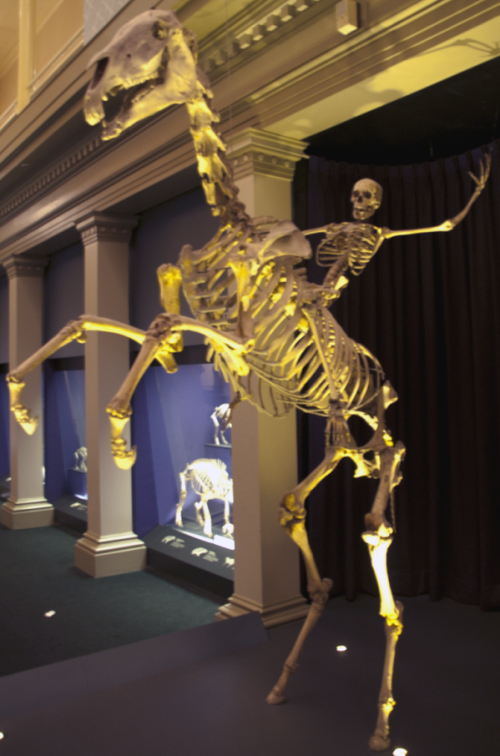
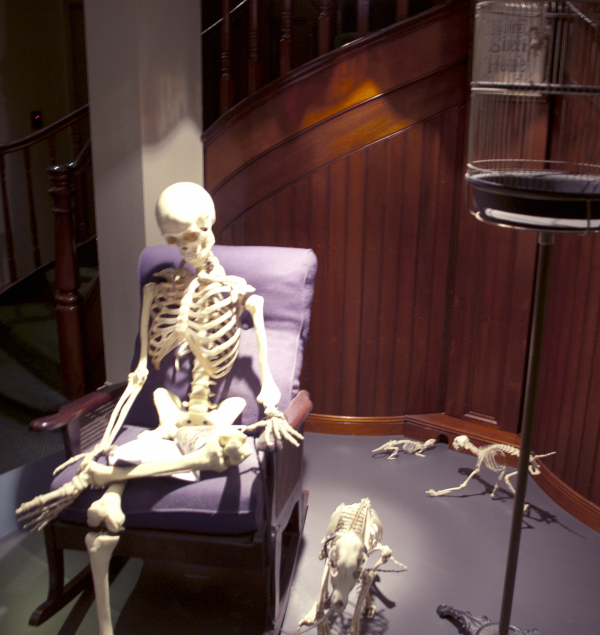
It wasn’t particularly nice out last Friday (Sept. 21), so we decided to go to the Australian Museum. It isn’t that big, but we still didn’t have enough time to see everything. The exhibits we saw were interesting and well put together. We mainly spent our time in the skeleton exhibit, the bird and insect exhibit, and I spent an hour or so in the dinosaur exhibit. Along with the normal animal skeletons mounted around the room for the visitors to inspect, the people who built the skeleton exhibit clearly had some fun with their job:

Skeletal Horseman

Yeee-Haw!

Home Sweet Home Skeleton

Ahh, a nice evening at home with the pets.

The bird and insect exhibit is a large balcony to the skeleton exhibit with taxidermied Australian birds in the wall cases and Australian insects in the display cases around the interior railing of the room. Adrienne spent the majority of her time here, taking pictures and reading about the birds and insects. They had some spiders spin webs in little boxes to put on display which was pretty cool.

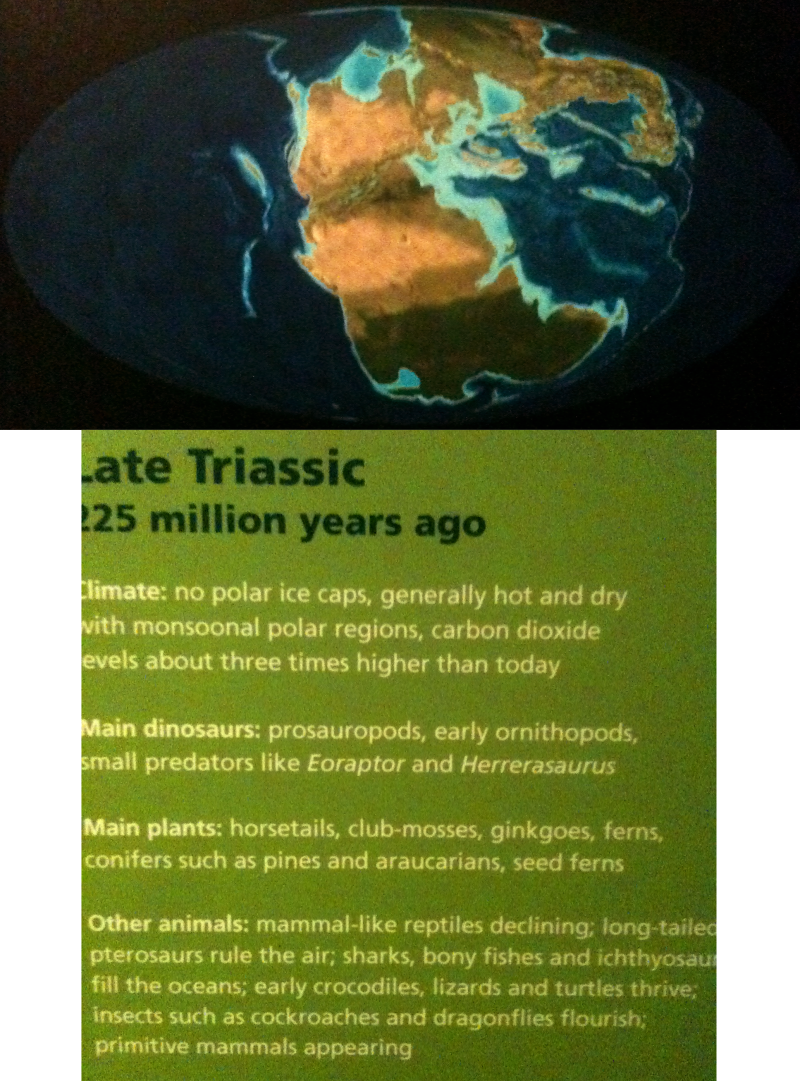
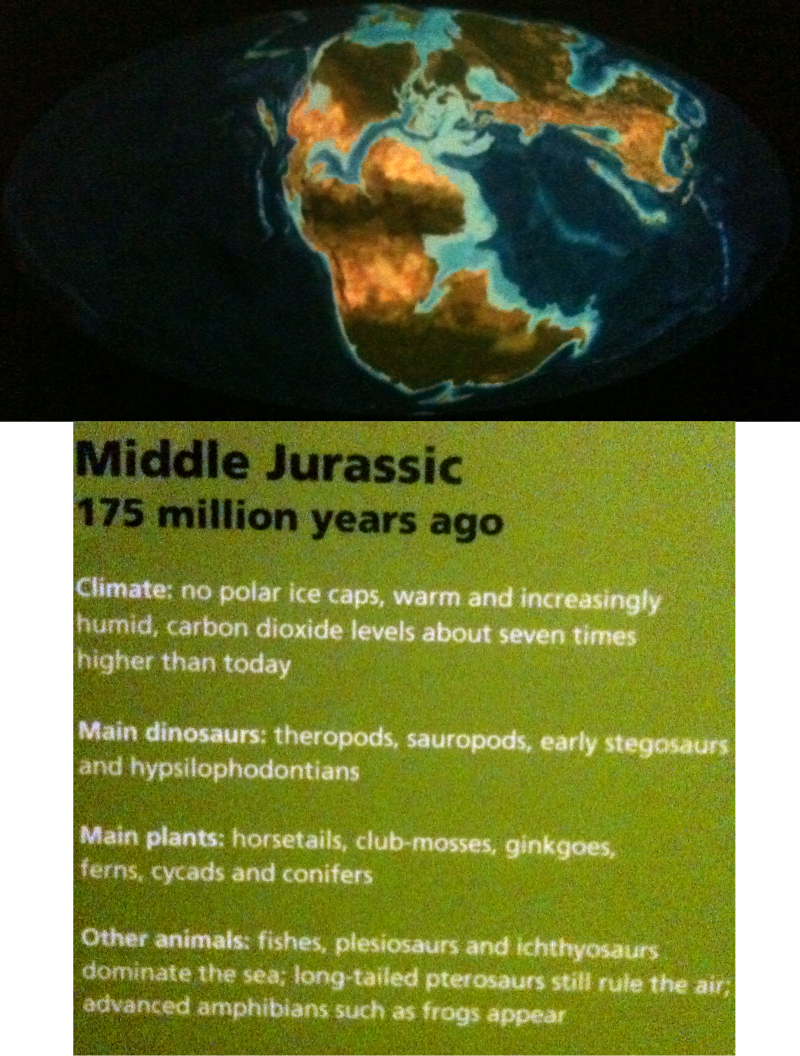
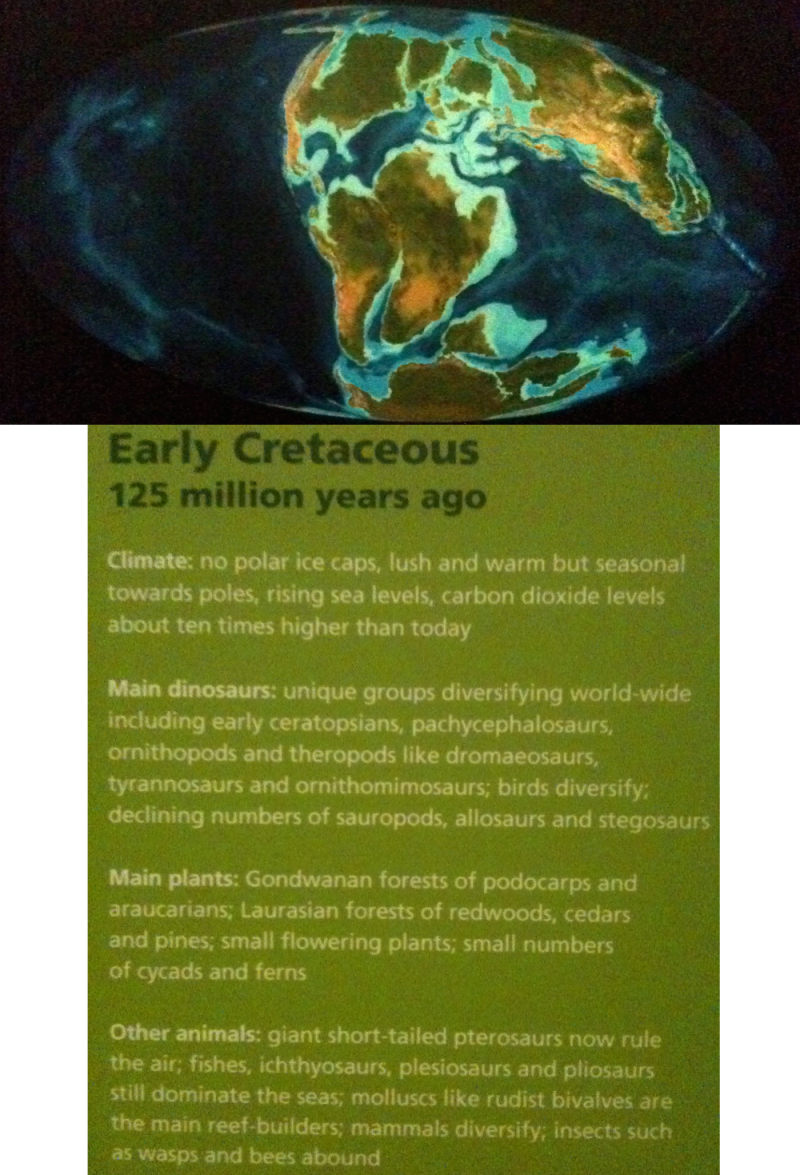
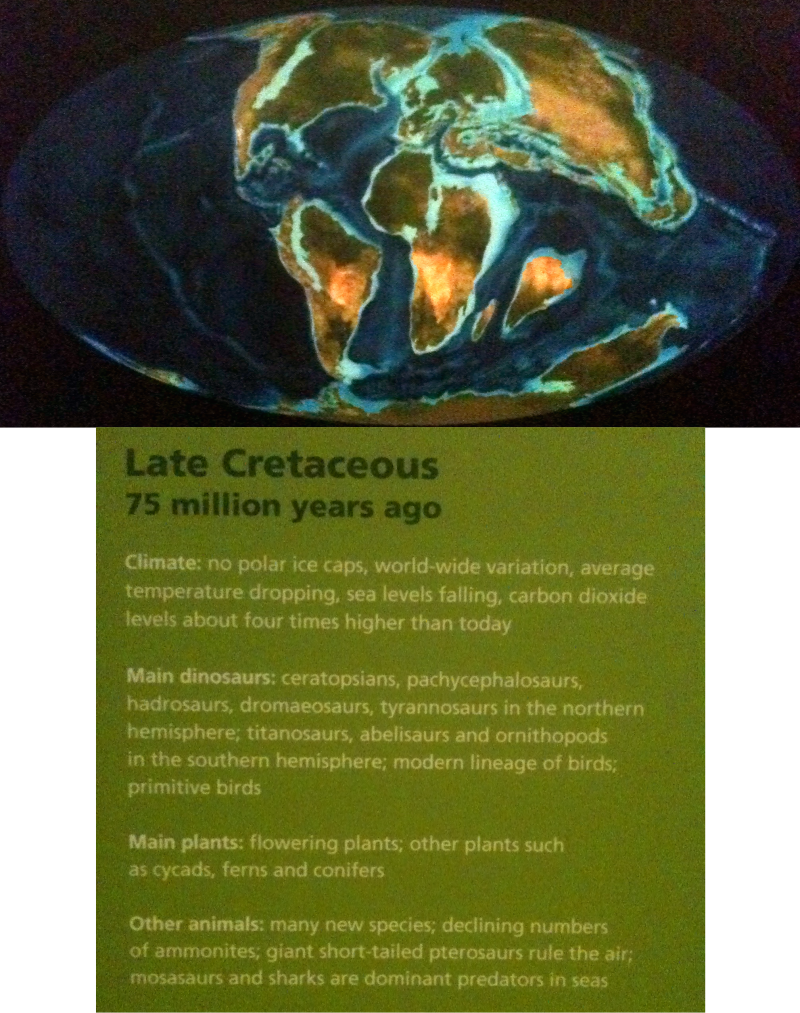
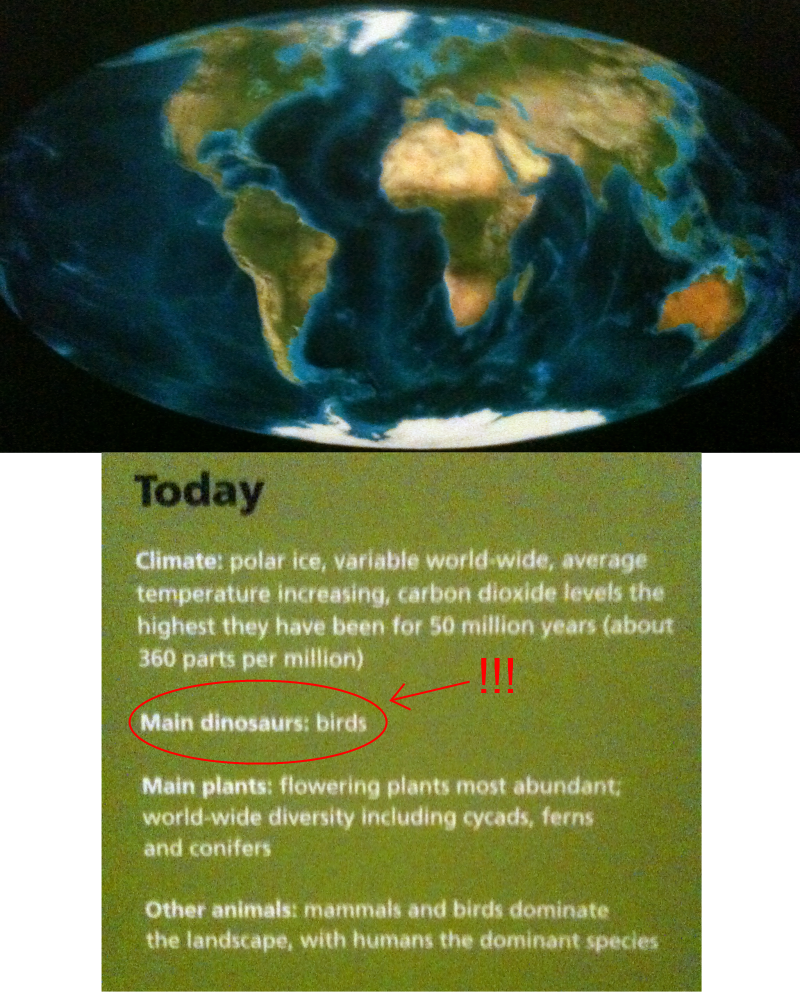
The dinosaur exhibit is fairly up to date and had some nice skeletons. It also had this great series of information about different time periods (click these to read the information about the period):

Late Triassic

The late Triassic, ~225 million years ago. This is the first time period that they showed. The Earth is mostly one giant continent.

Middle Jurassic

The Earth during the middle Jurassic ~175 million years ago.

Early Cretaceous

The continents start becoming what we know of them today around 125 million years ago in the early Cretaceous.

Late Cretaceous

Around 75 million years ago, in the late Cretaceous, there were apparently large seas cutting down the middle of the Americas, Africa, and Russia. The mass extinction event that killed the Dinosaurs happens about 10 millions years later at the end of the Cretaceous period.

Earth Today

Ah, Big Blue as we know her now. Wait, what’s that? There are still Dinosaurs?! That’s right, we think that some of today’s birds evolved from Dinosaurs like T-Rex and Velociraptor.

So next time you’re out an about and see a bird, think about this:

Velociraptor with feathers

Dinosaurs probably had feathers…

Another dino with feathers

… so when will the birds turn on us?

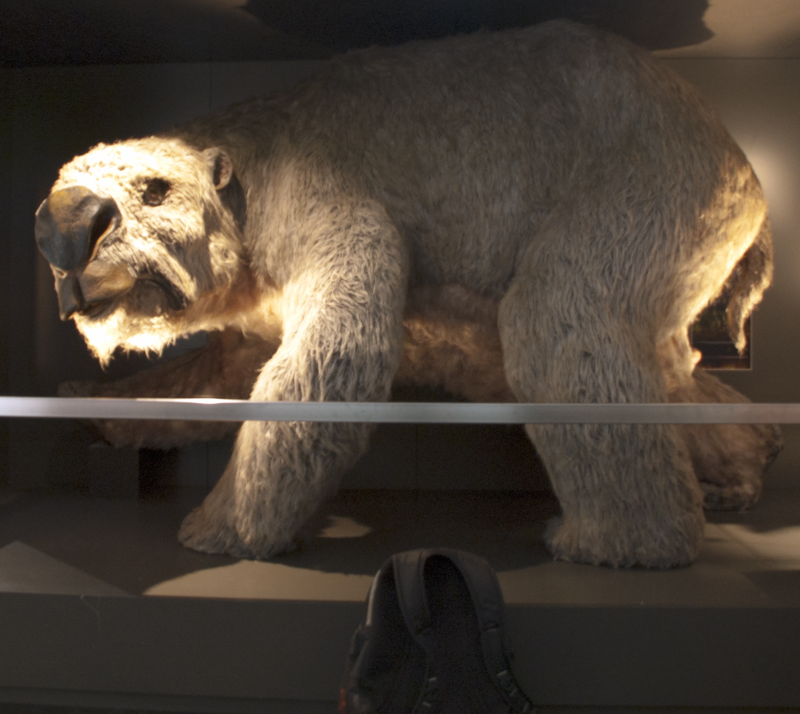
Giant Wombat

And by the way, Australia used to have a giant wombat (my backpack is there for scale). It was probably very goofy looking (this is a possible reconstruction).

Posted in Australia | 1 Comment

Blue Mountains: Take 1

Last Tuesday we took a train to the Blue Mountains, a national park on a very old mountain range a couple hours outside of Sydney. The park is very large; it spans at least three stops on the train. We hiked a trail to the Wentworth Falls part of the national park, and then one of the many trails in the Wentworth Falls area. It was spectacular.

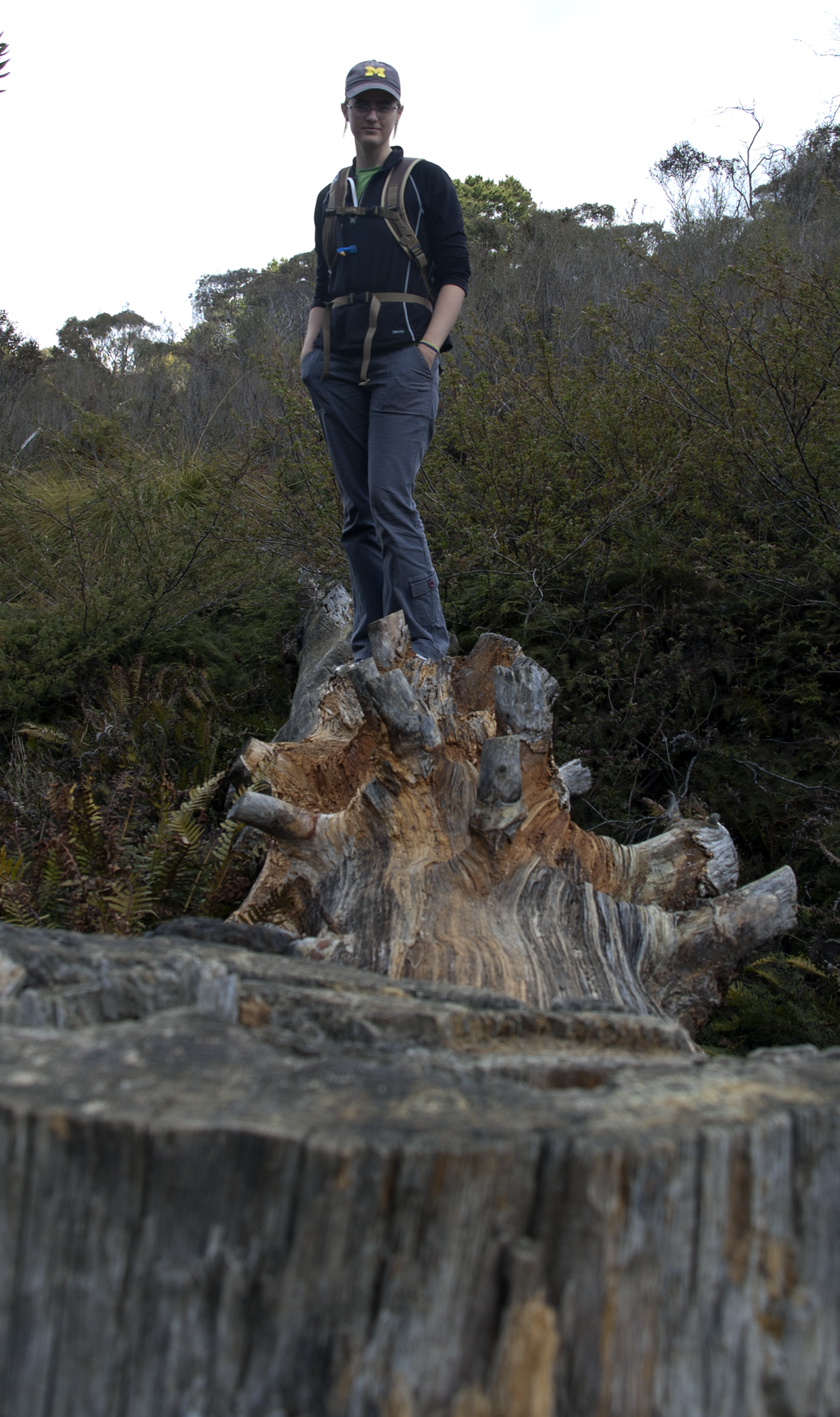
Adrienne's Log

Adrienne found a really beautiful tree that had been cut and was laying over the riverbed.

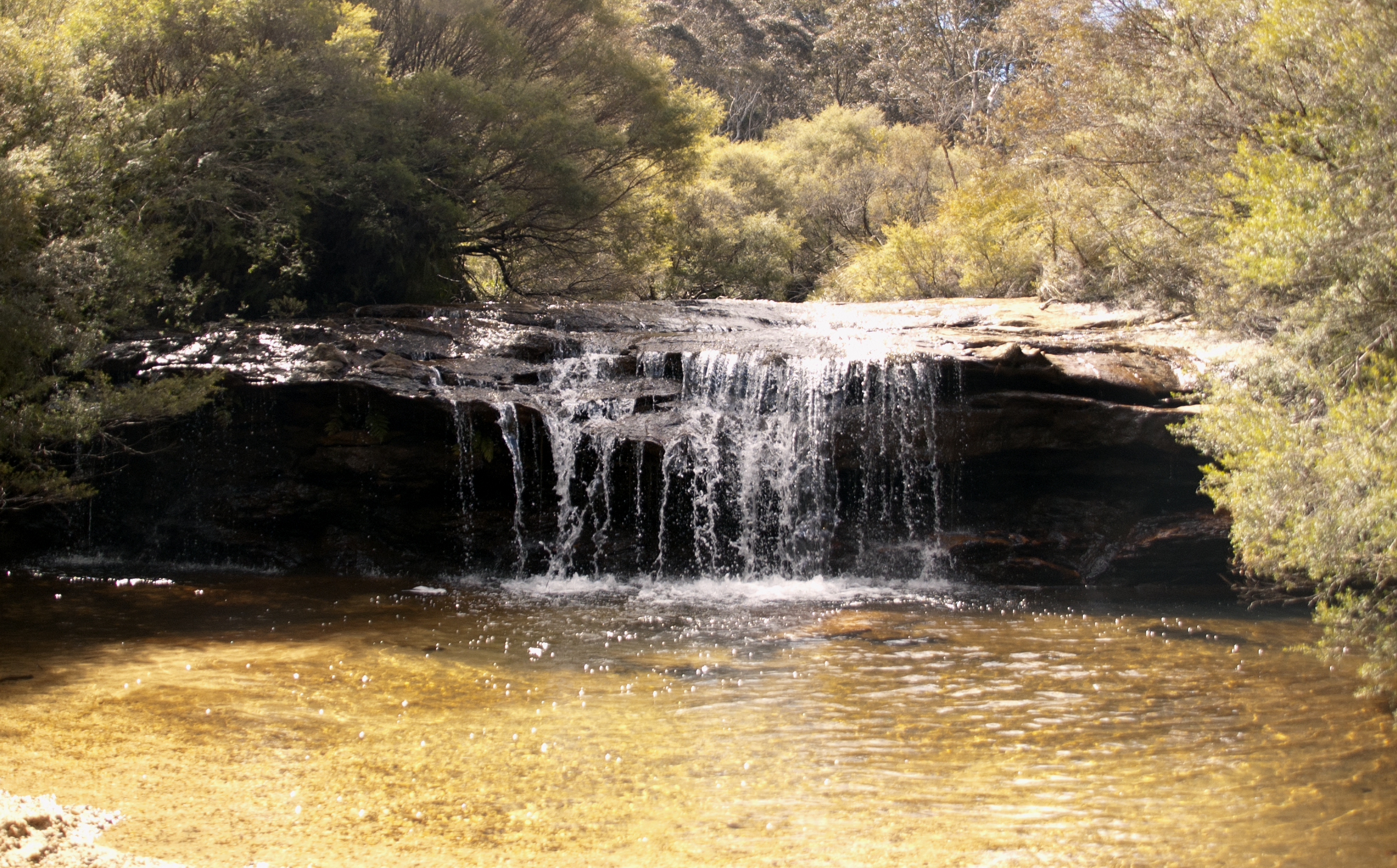
The first trail we walked starts in a park near the train station and runs alongside a small river. Other than the river, the area felt pretty dry.  A lot of the vegetation was brown or leafless and there were places that had burned relatively recently. It was still quite beautiful, with some cool sandstone walls, pretty birds, and there are many waterfalls along the river’s path. I even got to see a snake slithering away after Adrienne walked passed its hiding spot.

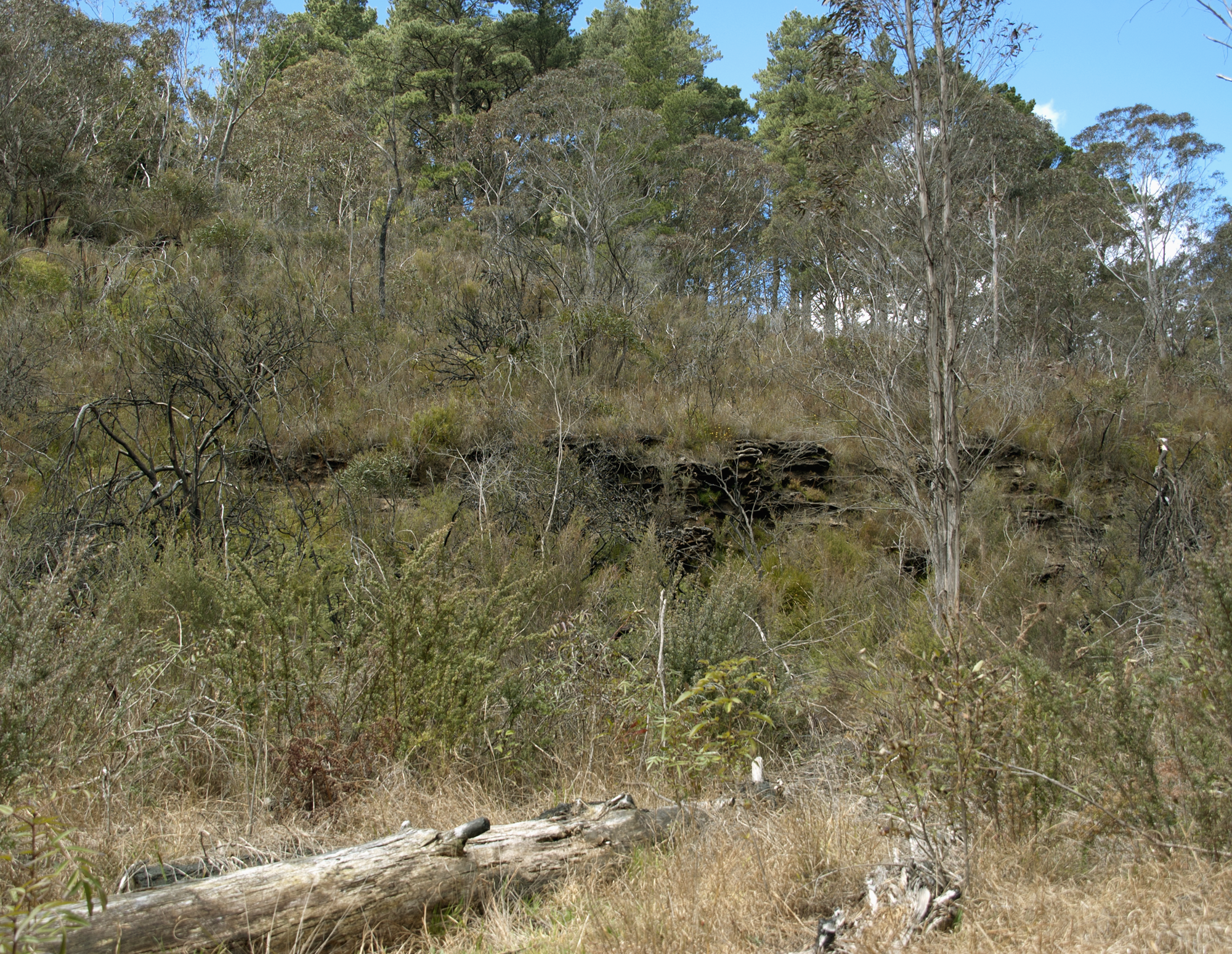
Dryness around an interesting sandstone wall

The sandstone walls can form some pretty amazing sculptures.

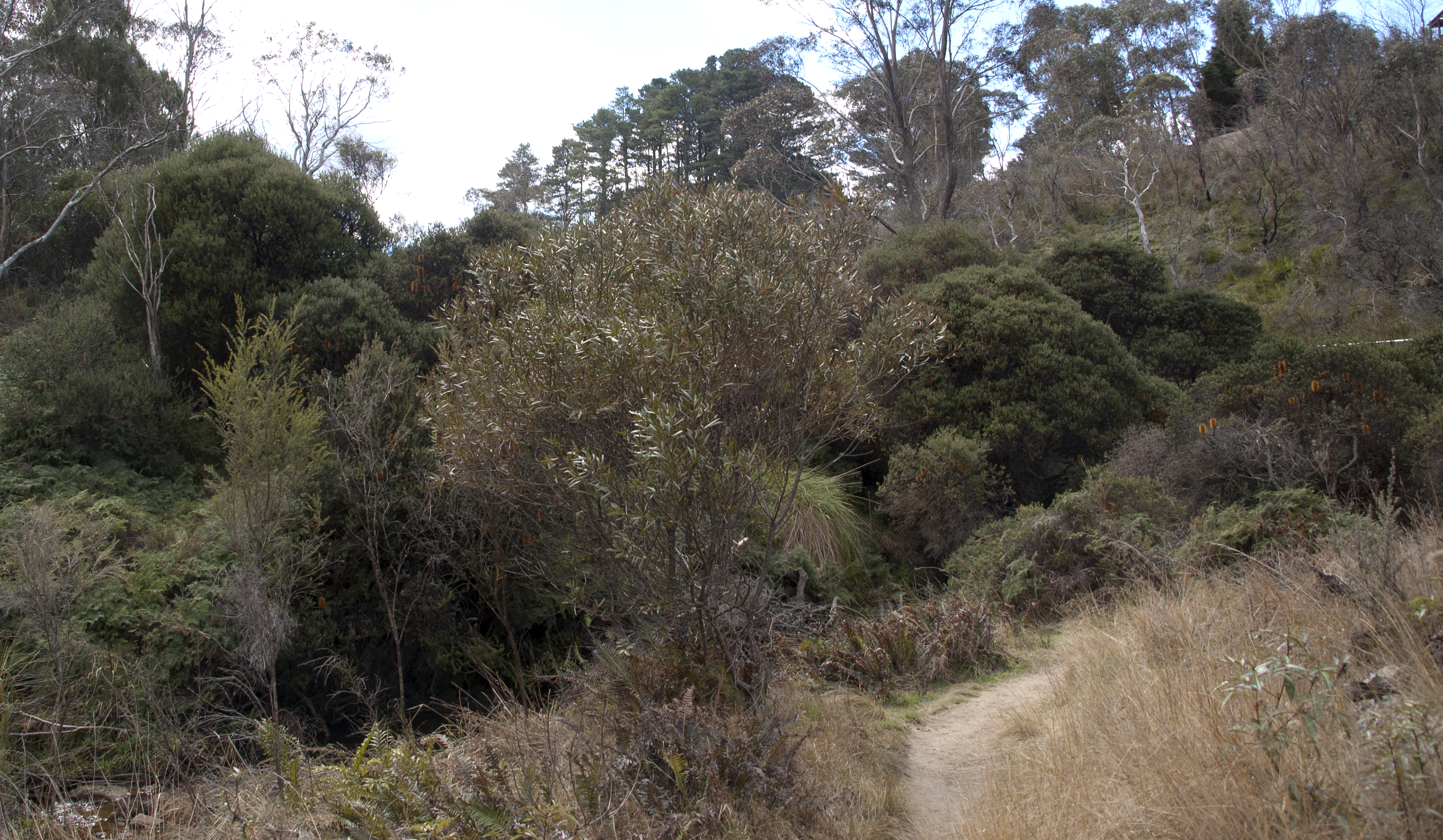
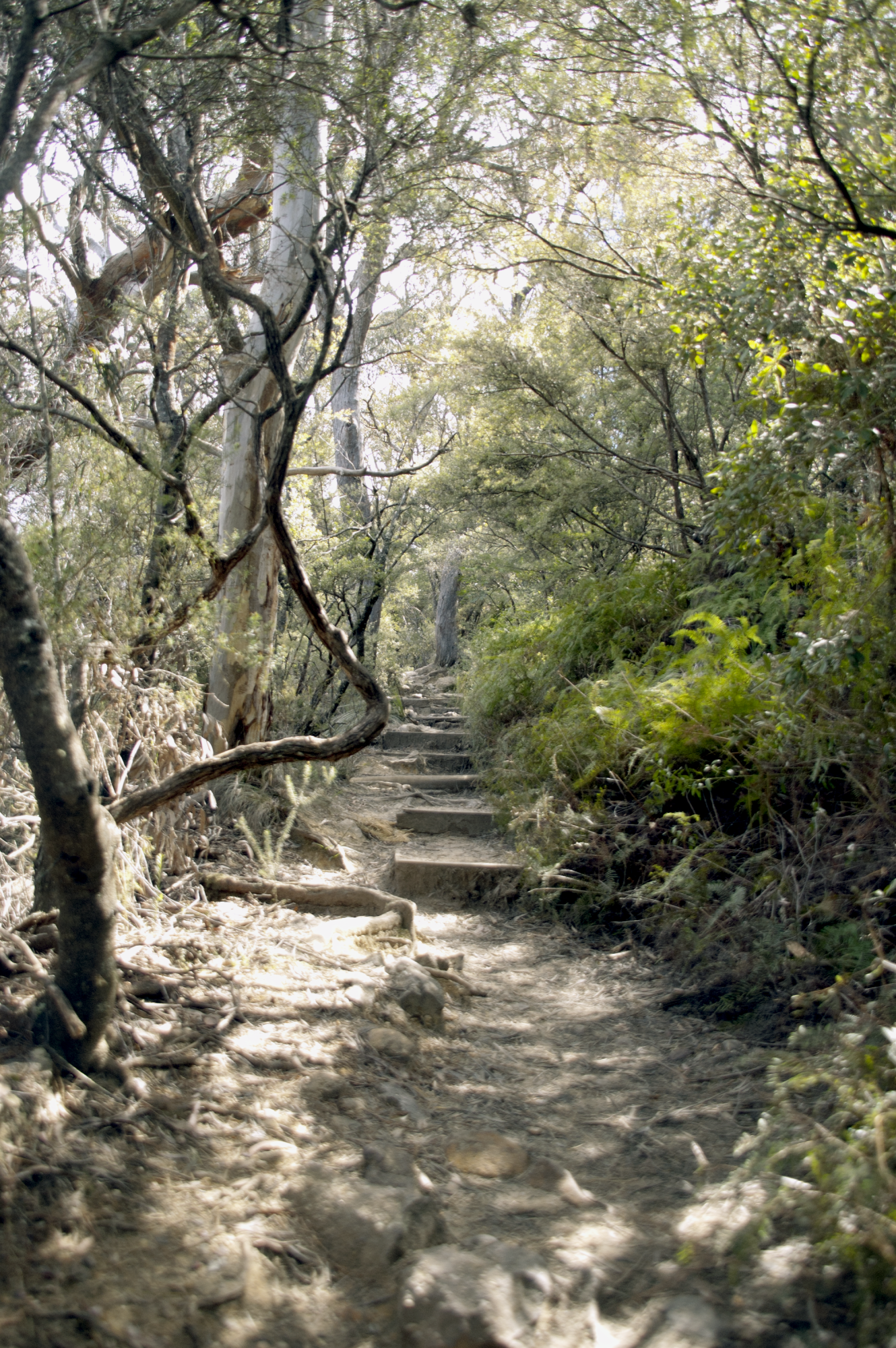
Dryness along the trail

You can see the trail here, the area felt very dry.

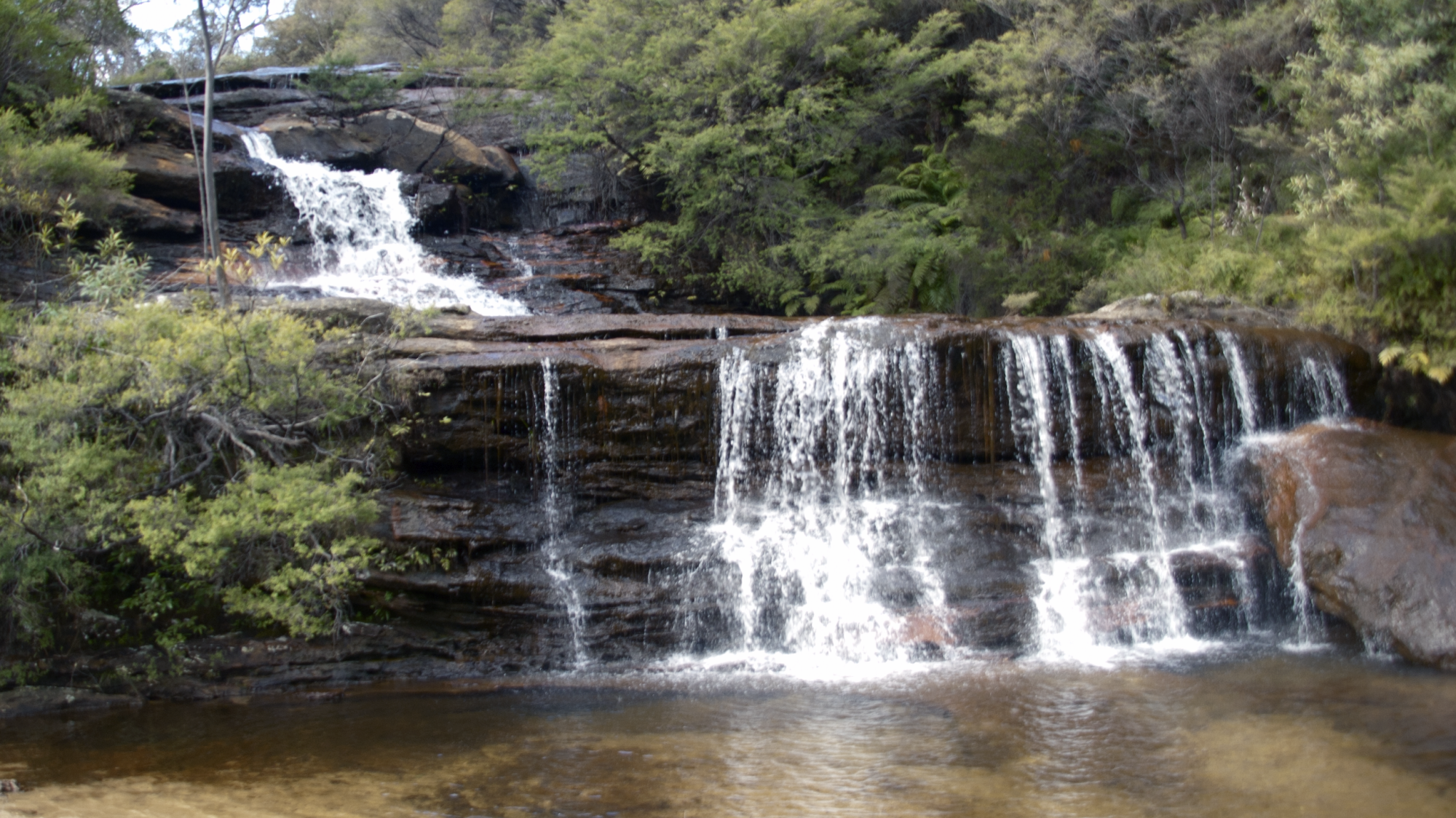
A waterfall

A waterfall about half way to the Wentworth Falls National Park area.

Getting lusher

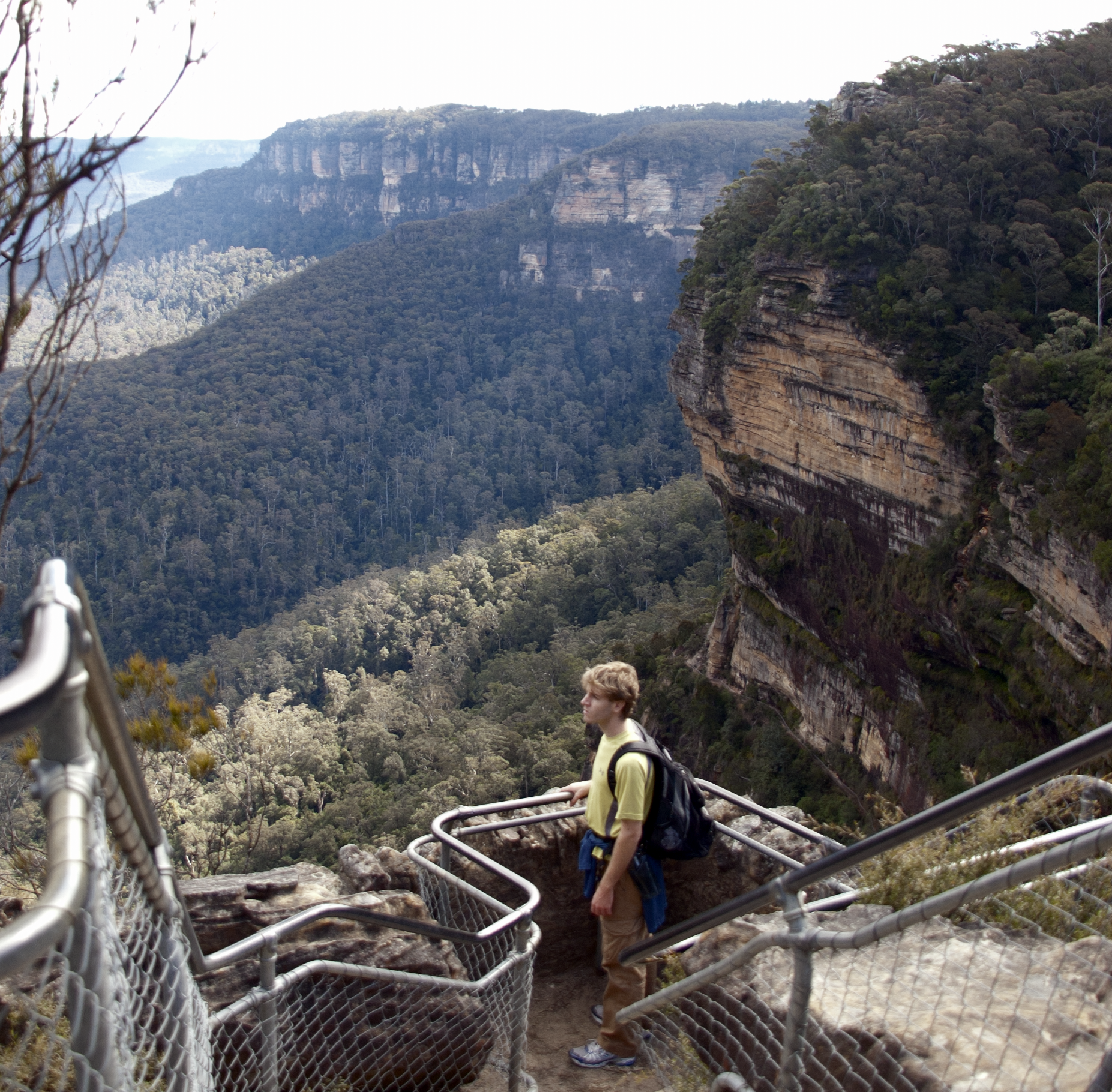
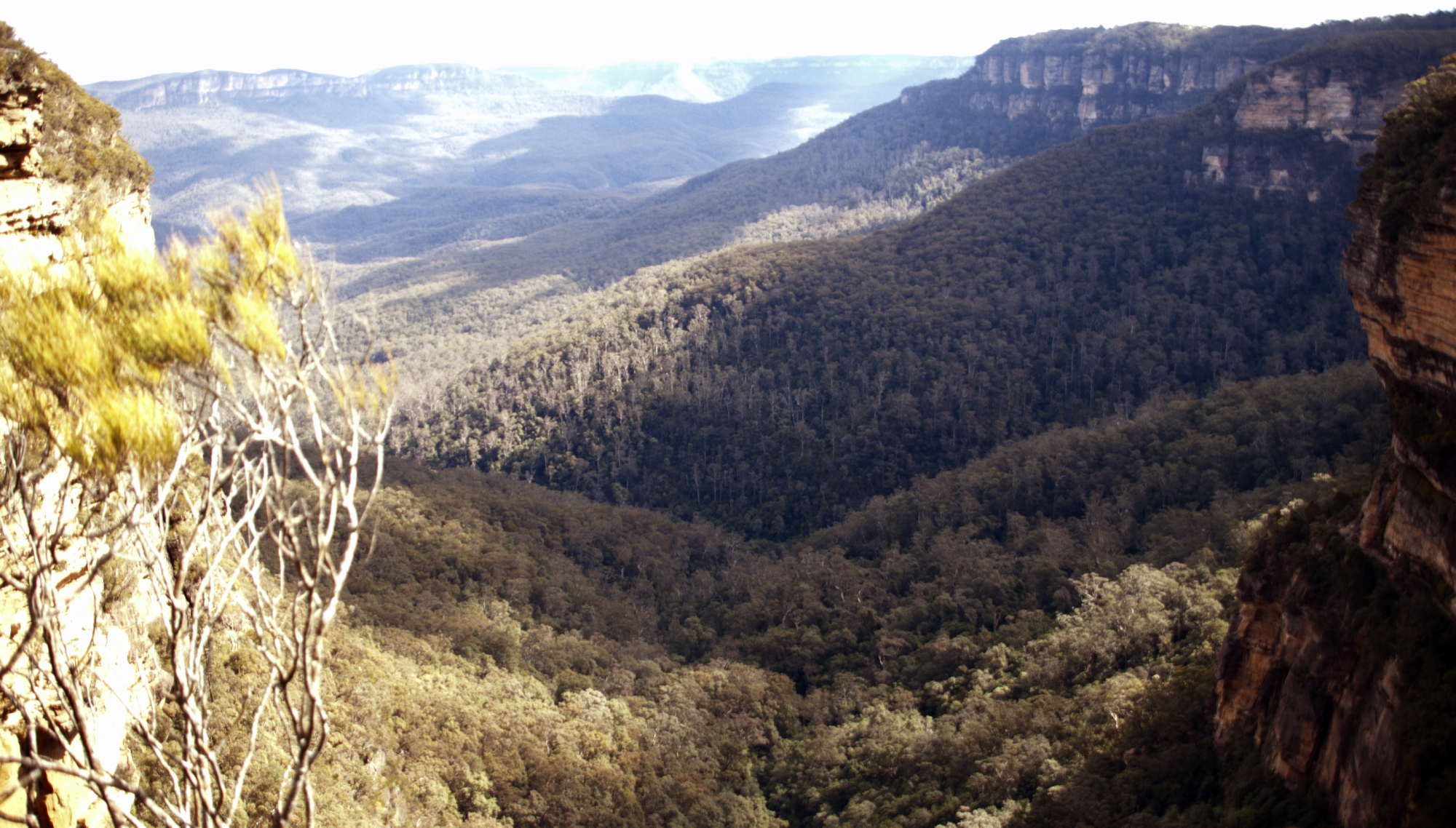
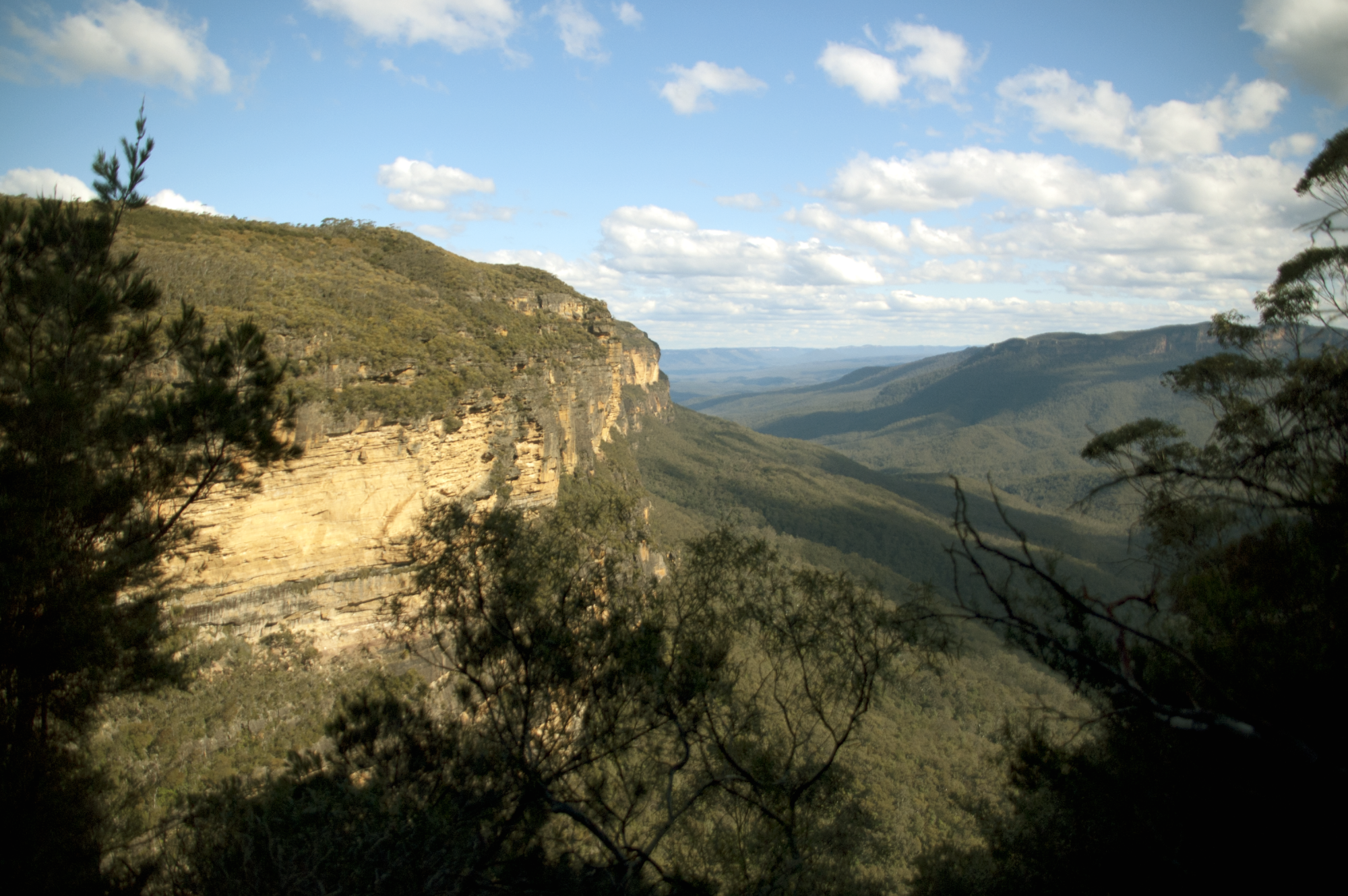
As we got into the Wentworth Falls area, the vegetation started to become more lush, the ground more damp, the humidity increased, and the waterfalls increased in size. And then we got to a lookout. Oh boy, was it stunning. I was frozen in place, staring out over an enormous valley, on top of a ~300 foot cliff. The valley is flanked by vibrantly colored sandstone walls, and headed by a giant waterfall, Wentworth Falls. We continued walking a path that took us along one of the walls of the valley, and every time I looked out over it, I was awestruck. The place is beautiful.

My first look over the valley

My first look over the valley. Wow.

Another view of the valley

Another view of the valley from a bit higher up.

Yet another view of the valley

This view was taken after we had walked to the right side of the other two pictures a bit, looking out to the left.

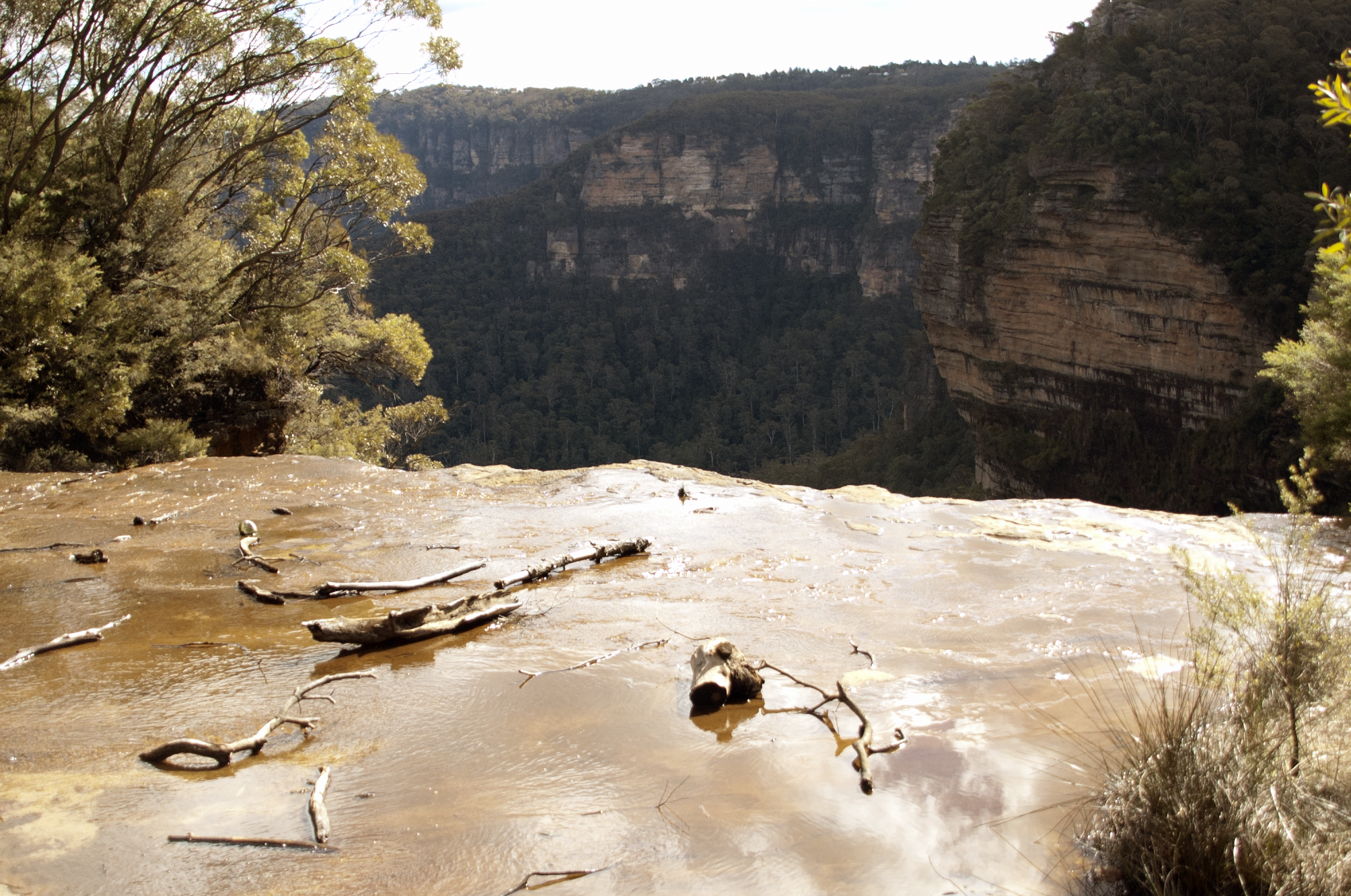
Waterfall at the top of Wentworth Falls

There is a path that walks across the top of Wentworth Falls. These waterfalls are are the top, facing away from the valley.

Valley from Wentworth Falls

This is looking out over the valley, with the previous picture behind. The path had an amazing warning sign on it, see Adrienne’s post for that.

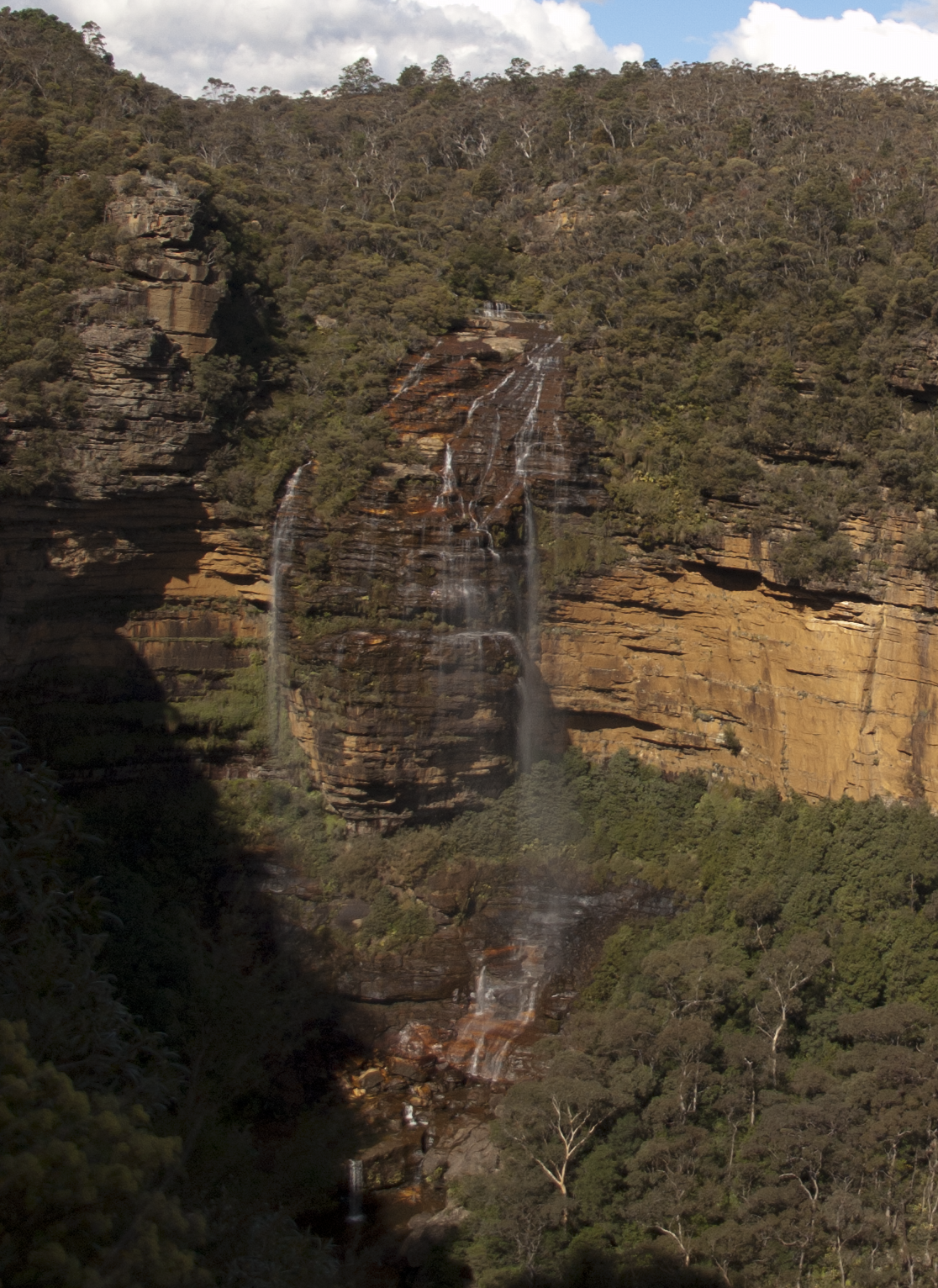
Wentworth Falls

After continuing down the trail, we got a great view of Wentworth Falls.

Wentworth Falls (with annotations)

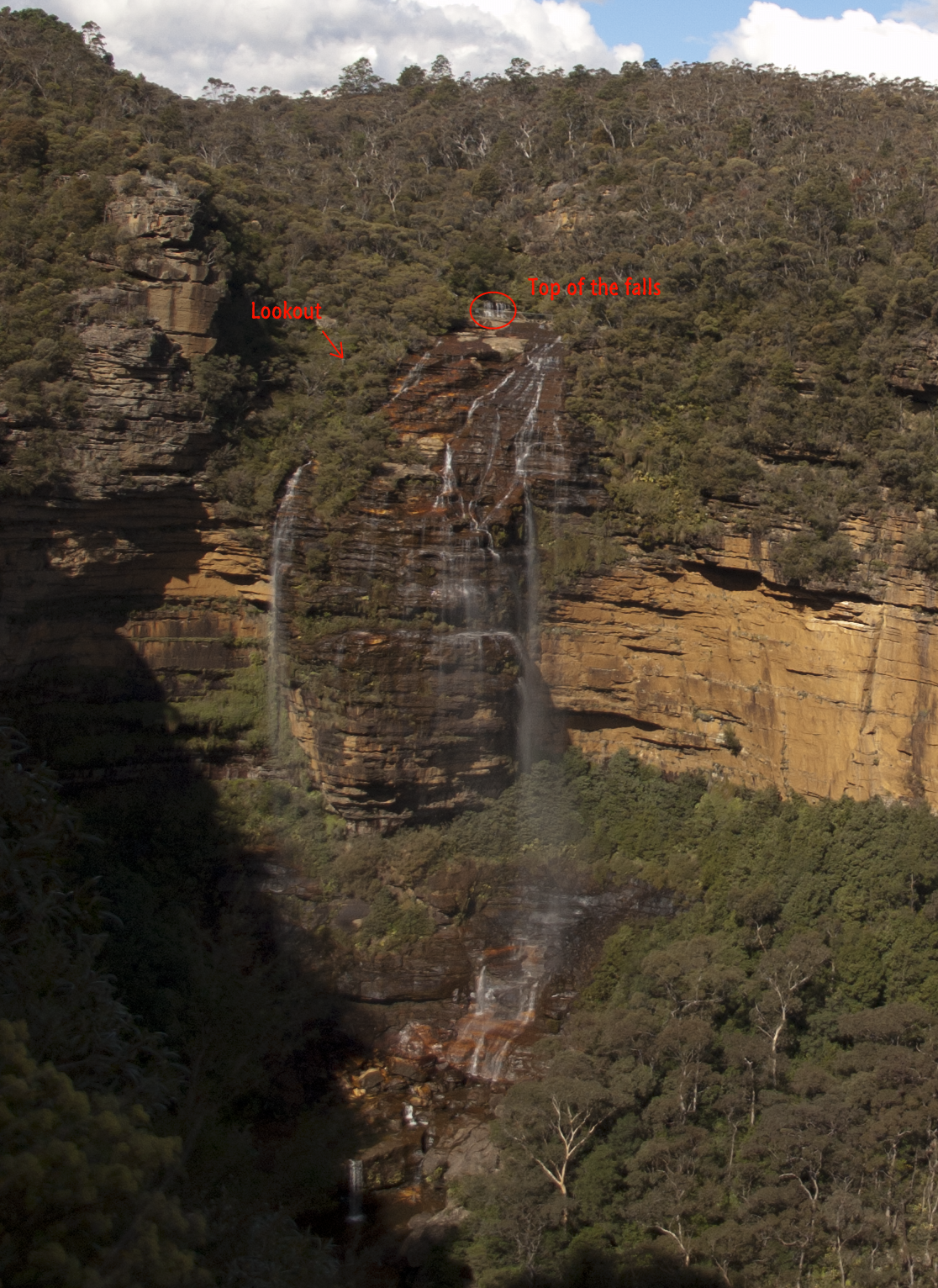
This should give some perspective on how big the waterfall is.

Overhang

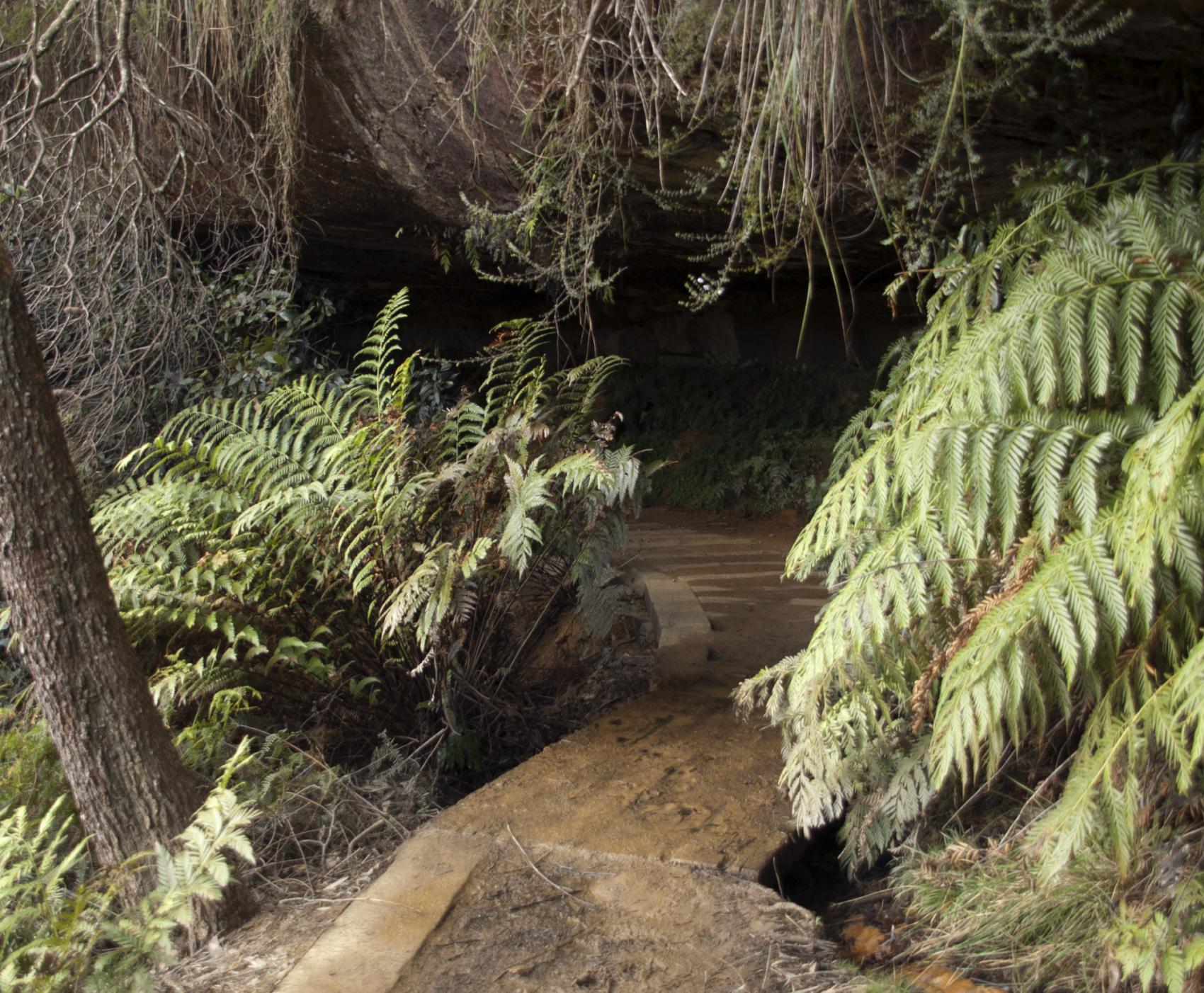
One of the overhangs along the trail.

The path we continued on is called the Undercliff/Overcliff hike, part of the hike goes through a bunch of cave-like overhangs that have been created, presumably, by thousands of years of erosion from the water that runs down the walls from above and plant growth (complete conjecture on my part.) The hike also goes along the top of the cliff wall (Overcliff) and gives incredible views of the valley below. On the Overcliff part of the hike, we ran across a few birds. The first was two female superb lyrebirds, they have really big feet they used to dig up brush looking for food. If you’ve never heard of a lyrebird, go watch this video. As long as we stood still, they didn’t seem to mind us and went about their business. Look for Adrienne’s post about this trip to see pictures of them.

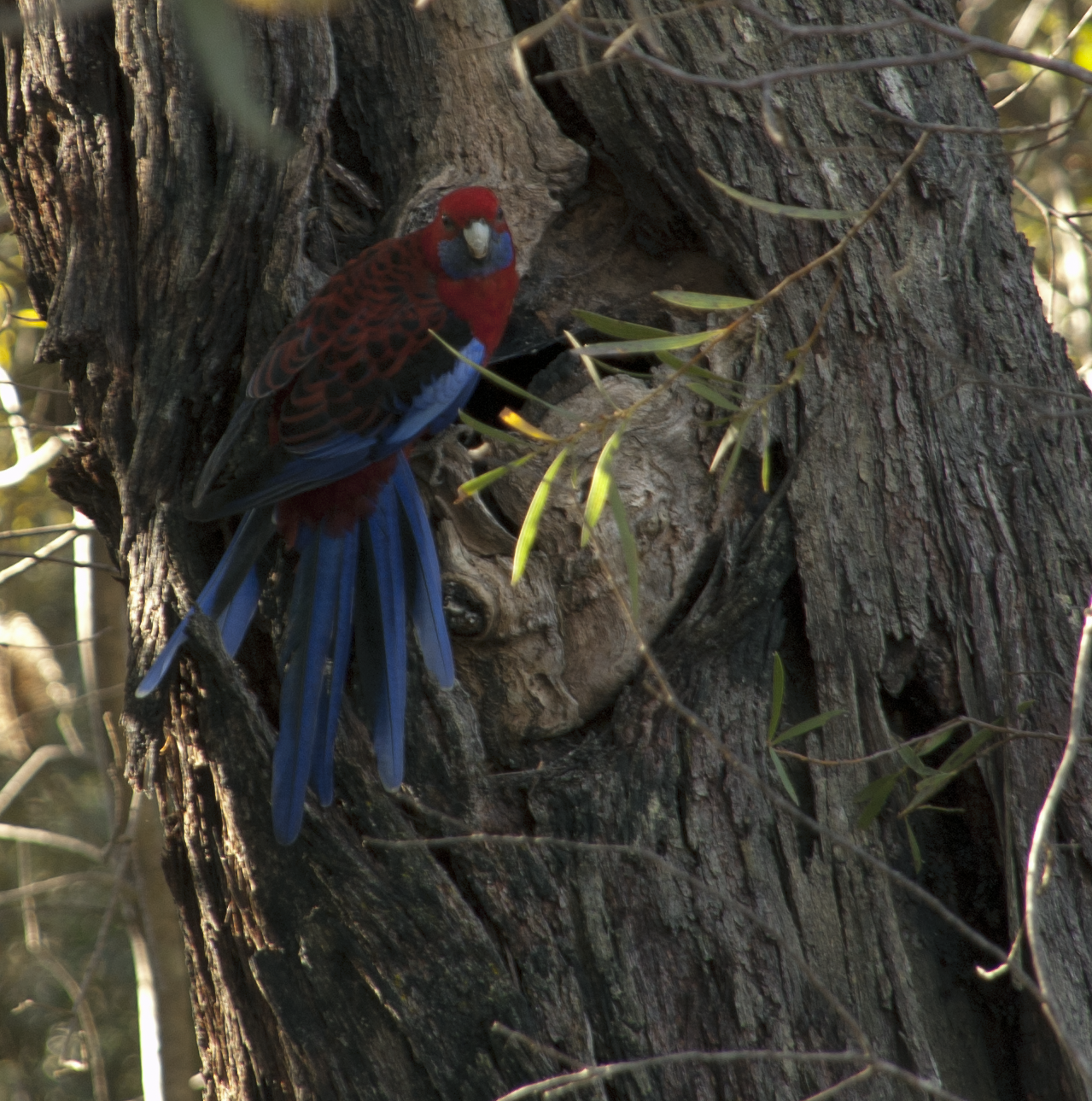
A

A crimson rosella sits near a hole in a tree.

The second was a pair of crimson rosellas. They were flitting around a hole in a tree that may have been their nest. Adrienne went into the bush to get some good pictures of them. What we saw of the Blue Mountains was amazing, and we’re going to go back to check out some other hikes later this week.

Posted in Australia | 1 Comment